Skip to content
Real-World AI Projects That Get You Hired
50 Expanded AI Project Ideas with Tools, Datasets, and Career Impact
“Recruiters don’t care about courses they care about proof.”
This guide presents 50 practical, real-world AI project ideas, each thoroughly detailed with a clear problem statement, step-by-step build process, recommended tools, relevant datasets, key learning outcomes, and an explanation of how it strengthens your job prospects.
Covering everything from beginner-level NLP tasks to advanced LLM-based agents, these projects are designed to bridge the gap between learning AI concepts and becoming job-ready.
Introduction: why projects win over certificates
Let’s start with a truth that most courses won’t tell you: finishing a Udemy certificate, watching YouTube tutorials for six months, or completing an online bootcamp does not make you hireable on its own. Recruiters and hiring managers at AI companies startups and FAANG alike are not impressed by a list of courses on your resume. What stops them in their tracks is a GitHub repository with a working, deployed project they can click through.
The AI job market in 2026 is uniquely competitive. The barrier to learning has never been lower millions of people are watching the same tutorials, reading the same documentation, and listing the same frameworks on their resumes. The barrier to doing, to building something that actually runs, is where most people stop. That gap between consuming knowledge and applying it is exactly where your career opportunity lives.
Projects serve as proof of multiple compounding skills simultaneously. They show that you can set up a development environment, source and clean a real-world dataset, choose an appropriate model or architecture, write code that does not break in production, debug when things go wrong, and eventually ship something a user can interact with. Each of those steps is a distinct skill. A certificate proves only that you watched someone else execute them.
Beyond the hiring signal, building projects accelerates your learning in ways passive study cannot replicate. When you hit a genuine error at 11pm not a curated exercise error, but a real, cryptic traceback that throws you into the deep end of Stack Overflow and you figure it out, that knowledge becomes permanent. Projects force you into the messy, non-linear reality of engineering work, which is precisely what you will encounter on day one of your new job.
This guide gives you 50 fully expanded AI project ideas. Each one includes a clear problem statement, what you will actually build, the exact tools and libraries to use, where to find the data, a step-by-step implementation outline, what you will learn, and why that specific project resonates with hiring managers. Use this as your project roadmap pick one, build it properly, deploy it, document it, and move to the next.
Everyone Who Codes your career partner
Before you dive in, bookmark the platform that bridges the gap between learning and
landing your first AI role: everyonewhocode.com
Whether you need structured guidance, accountability, or a mentor who has been in
the rooms where hiring decisions are made, Everyone Who Codes has a path for you.
Mock interviews. Resume reviews. 1-on-1 mentorship. Free FAANG prep resources.
Visit: everyonewhocode.com
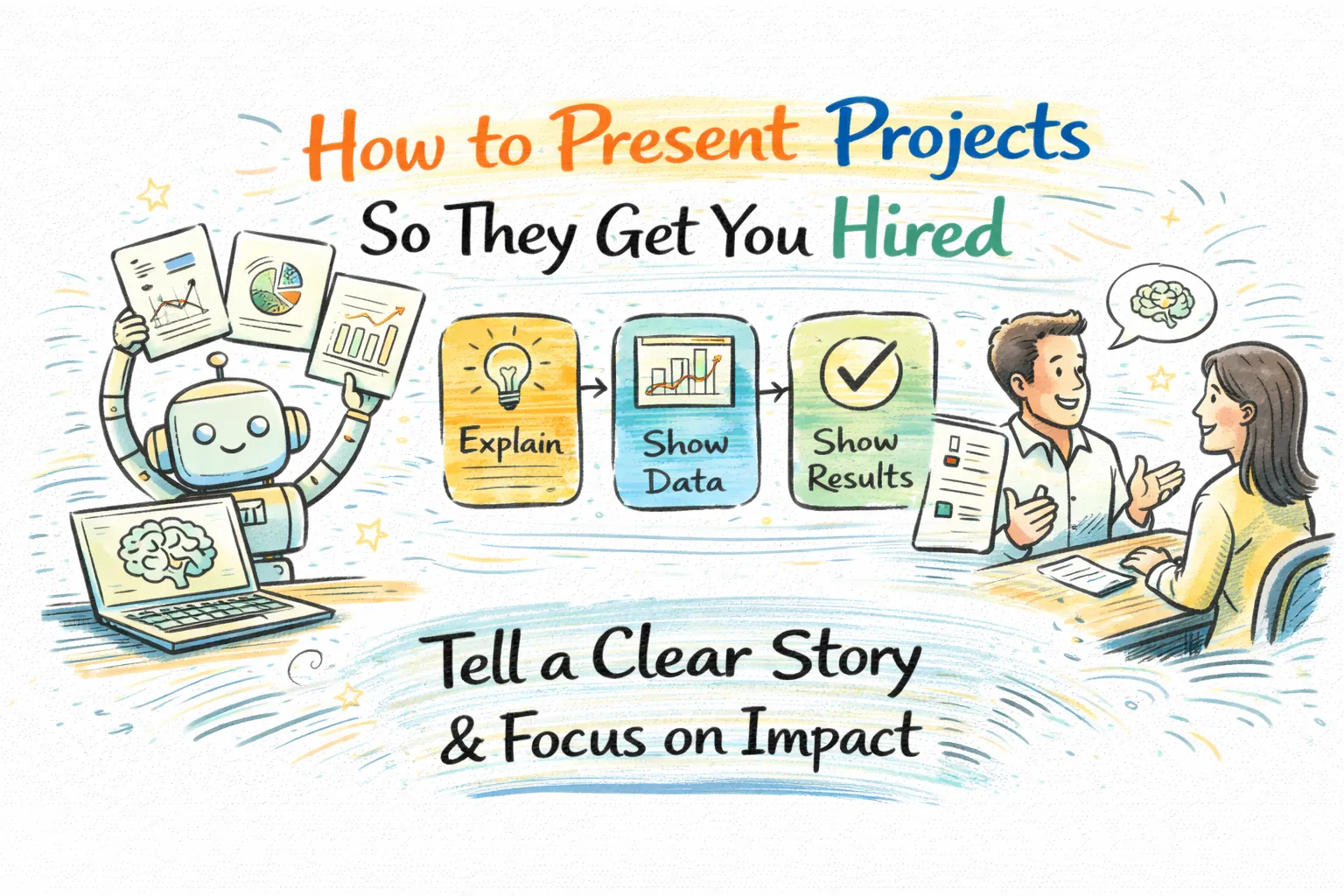
How to present projects so they get you hired
Building a great project is half the equation. The other half is how you package and present it. A recruiter who clicks your GitHub link and finds a single Jupyter notebook with no README, no comments, and no demo will move on in seconds. Here is the framework that consistently converts portfolio views into interview calls.
1. The GitHub repository standard
Every project needs a clean, professional GitHub repository. The README is your project’s front door it should include a one-paragraph overview of what problem you solved and why it matters, the tech stack you used, clear setup and installation instructions so someone can run your code in under five minutes, screenshots or a GIF of the working application, and a link to the live demo if one exists. Write code comments that explain your reasoning, not just what the code does. Structure your folders with intention. Treat your repository as if a senior engineer at your dream company will review it during a hiring decision because they very well might.
2. Deploy a live demo
A live, interactive demo is the single most powerful thing you can add to a portfolio project. Tools like Streamlit, Gradio, and Hugging Face Spaces allow you to deploy a working web interface for free, often in under an hour of work. When a recruiter can type a question into your chatbot, upload an image to your classifier, or generate a prediction with your forecasting model, that hands-on interaction creates a memory they associate with your name. Static notebooks do not create that experience. Make it interactive, make it accessible, and link it prominently in your README.
3. Tell the story in interviews
For every project you list on your resume or portfolio, prepare a structured 90-second narrative: what problem you were solving and why it interested you, what the technical challenge actually was, what approaches you tried that did not work and why, what you ultimately built and how it performed, and what you would do differently if you rebuilt it today. This is the structure interviewers are probing for when they say ‘walk me through a project you worked on.’ They are not looking for a feature list. They are evaluating your engineering judgment, your problem-solving process, and your capacity to reflect and learn.
4. Common portfolio mistakes to avoid
Only doing Titanic and Iris datasets every recruiter has seen hundreds of these. They signal that you have not moved past tutorials. Build projects that solve real or at least realistic problems. Missing README and no context a repository without a README is invisible. Quantity over depth twenty shallow projects are worth far less than three well-built, deployed, documented ones. Skipping the why every project needs a problem statement that explains the real-world relevance. No evaluation metrics show precision, recall, F1-score, confusion matrices, and discuss why you chose those metrics and what trade-offs you made. These small choices signal genuine understanding versus copy-paste implementation.
Want expert feedback on your portfolio before applying?
Book a 1-on-1 mentorship session at Everyone Who Codes and get personalized
guidance from engineers who review portfolios and make hiring decisions.
1-on-1 Mentorship: everyonewhocode.com/services/1-1-tech-mentorship/
Free FAANG Prep: everyonewhocode.com/free-faang-interview-preparation/
Category 01 natural language processing (nlp) projects
Natural Language Processing is one of the most accessible entry points into AI because the raw material text is everywhere. From social media posts and product reviews to legal contracts and medical records, text data is abundant and the problems it unlocks are immediately recognizable to any hiring manager. These ten projects cover the core NLP skill set: text classification, entity recognition, sentiment analysis, sequence modeling, and transformer-based approaches.
Project 01: fake news detector
Misinformation spreads faster in the digital age than at any point in history. AI-powered fake news detection is one of the highest-impact applications of NLP, and it’s a project that resonates instantly with any recruiter who reads the news.
Problem statement: Distinguishing false or misleading news articles from legitimate ones at scale, without human review, is a critical unsolved challenge for media platforms, social networks, and democratic institutions.
What you will build: A binary text classifier that takes a news headline or full article as input and outputs a prediction: real or fake, along with a confidence score. Build a Streamlit interface so users can paste any headline and get an instant result.
Tools & Libraries: Python, BERT or DistilBERT (HuggingFace Transformers), scikit-learn, Pandas, Streamlit
Dataset: LIAR Dataset (Kaggle) or the Fake and Real News Dataset both labeled and publicly available
How it works:
- Load and explore the labeled dataset; understand the class distribution and check for imbalance
- Preprocess text: lowercase, remove HTML, tokenize using the BERT tokenizer
- Fine-tune a pre-trained DistilBERT model for sequence classification on your train split
- Evaluate with precision, recall, F1-score, and a confusion matrix on the held-out test set
- Build a Streamlit interface that accepts user-pasted text and returns a prediction with confidence
What you will learn:
- Text preprocessing and tokenization for transformer models
- Transfer learning and fine-tuning a pre-trained model on a downstream task
- Handling class imbalance in NLP classification datasets
- Model evaluation beyond accuracy: interpreting F1 and confusion matrices
Why this gets you hired: Media-tech, civic-tech, and cybersecurity companies are actively building fake news detection tools. This project shows NLP skill, social awareness, and the ability to build something with real-world stakes a combination that stands out in every interview.
Project 02: Resume parser and ranker
Recruiting is a data problem at scale. Most applicant tracking systems rely on naive keyword matching, producing poor results. An AI-powered resume parser that understands context and relevance is a much better solution.
Problem statement: Recruiters spend enormous time manually screening hundreds of resumes. A model that extracts skills, experience, and education and ranks candidates against a job description can save hours per role.
What you will build: A system that accepts multiple PDF resumes and a job description, extracts structured information using NLP, computes semantic similarity between each resume and the job requirements, and ranks candidates from most to least relevant with a short explanation.
Tools & Libraries: Python, spaCy, NLTK, PyMuPDF or PDFMiner (for PDF parsing), sentence-transformers for semantic similarity, Streamlit
Dataset: Kaggle Resume Dataset contains labeled resumes across job categories. Supplement with real job descriptions from LinkedIn or Indeed.
How it works:
- Build a PDF text extractor using PyMuPDF; handle multi-column layouts and parse section headers
- Use spaCy’s Named Entity Recognition to extract skills, degrees, job titles, and years of experience
- Encode both the job description and each resume using a sentence-transformer model (e.g., all-MiniLM-L6-v2)
- Compute cosine similarity between each resume embedding and the job description embedding
- Rank and display results with matched skills highlighted and a compatibility score per candidate
What you will learn:
- PDF parsing and unstructured text extraction
- Named Entity Recognition (NER) using spaCy
- Semantic similarity with sentence transformers and cosine distance
- Building practical HR-tech pipelines with real document inputs
Why this gets you hired: HR technology is a multi-billion dollar market and AI-powered hiring tools are its fastest growing segment. Building this project proves you can combine NLP with a real business process the kind of applied thinking that companies value enormously.
Project 03: Sentiment predictor for product reviews
Every online retailer, SaaS product, and service business receives thousands of text reviews. Understanding the emotional tone of that feedback at scale without reading every review manually is a foundational business intelligence problem.
Problem statement: Manually reading thousands of reviews to understand customer sentiment is impractical. An automated system that classifies reviews as positive, negative, or neutral and surfaces trends is immediately useful to any business.
What you will build: A sentiment classifier that takes raw review text and outputs a sentiment label and confidence score. Extend it with a dashboard showing sentiment distribution over time, most frequent positive and negative keywords, and examples of each class.
Tools & Libraries: Python, HuggingFace Transformers (RoBERTa or VADER for lighter use), scikit-learn, Pandas, Matplotlib, Streamlit
Dataset: Amazon Product Reviews dataset (Kaggle) or IMDb Movie Reviews dataset both widely used and well-labeled
How it works:
- Load and explore the dataset; examine the distribution across sentiment classes
- Preprocess: strip HTML, handle contractions, tokenize with the model’s tokenizer
- Fine-tune a RoBERTa model for 3-class sentiment classification on the training set
- Evaluate with per-class precision, recall, and F1; examine misclassified examples to understand failure modes
- Build a Streamlit dashboard showing sentiment trends, word clouds per class, and a live classification input
What you will learn:
- Multi-class text classification with transformer models
- Analyzing model errors and identifying patterns in misclassification
- Data visualization and dashboard design with Streamlit and Matplotlib
- Understanding how sentiment models are used in real business intelligence contexts
Why this gets you hired: Sentiment analysis is one of the most deployed NLP applications in industry. Building a polished version with a real dashboard not just a model notebook demonstrates the full product thinking that distinguishes junior developers from engineers companies want to hire.
Project 04: Autocorrect and autocomplete tool
Autocorrect is something every person uses every day, yet most developers have never built one. Implementing it from scratch reveals the elegance of probabilistic language models and gives you deep intuition for how language prediction works.
Problem statement: Typing errors are universal and constant. An autocorrect system must identify likely misspellings and suggest the most contextually appropriate correction a harder problem than it first appears.
What you will build: A Python-based autocorrect tool that suggests the most likely correction for any misspelled word, using edit distance for candidate generation and a language model for context-aware ranking. Extend it with an autocomplete feature that predicts the next word given a partial sentence.
Tools & Libraries: Python, NLTK (for tokenization and corpus access), TextBlob (for baseline), BERT (for context-aware correction), Streamlit
Dataset: Wikipedia corpus (available via NLTK) for language model training; custom sentence test set for evaluation
How it works:
- Implement a baseline spell checker using minimum edit distance (Levenshtein distance) to generate candidate corrections
- Build a unigram and bigram language model from a large text corpus to rank candidates by probability
- Upgrade to a BERT-based masked language model that predicts the most likely correction in context
- Add an autocomplete feature: given partial input, predict the top 3 most likely next words
- Deploy via Streamlit with real-time word prediction as the user types
What you will learn:
- Edit distance algorithms and how they are used in NLP systems
- n-gram language models and probability-based word prediction
- How masked language modeling works in BERT and how to use it for word prediction
- Real-time interactive NLP application development
Why this gets you hired: This project is a perfect conversation starter in interviews because it covers multiple layers of NLP algorithms, probability, and deep learning in one coherent system. It shows intellectual range and the ability to build something deceptively simple but technically rich.
Project 05: Social media spam detector
Bot accounts and spam comments contaminate social media platforms, spreading misinformation, promoting scams, and degrading the user experience. Automated detection is essential at any scale.
Problem statement: Identifying spam comments from legitimate ones on platforms like YouTube or Instagram requires understanding not just keywords but context, repetition, and suspicious patterns a natural NLP classification problem.
What you will build: A spam detection classifier trained on labeled YouTube comment data that identifies whether a new comment is spam or legitimate. Add a simulation feature where users can input a comment and see a prediction with reasoning.
Tools & Libraries: Python, BERT or ALBERT (HuggingFace), scikit-learn, NLTK, Pandas, Streamlit
Dataset: YouTube Spam Collection Dataset (UCI Machine Learning Repository) 5 different YouTube video comment datasets labeled as spam or ham
How it works:
- Load and explore the dataset; note the class imbalance between spam and legitimate comments
- Preprocess: lowercase, remove URLs and special characters, tokenize
- Train a TF-IDF + Logistic Regression baseline; then fine-tune a BERT or ALBERT model to compare
- Evaluate both models; analyze false positives (legitimate comments flagged as spam) carefully
- Build a Streamlit interface where users paste comments and get classification results with confidence
What you will learn:
- Handling class imbalance with oversampling or weighted loss functions
- Comparing traditional ML (TF-IDF + Logistic Regression) to modern transformer approaches
- Understanding why false positives matter more than false negatives in moderation contexts
- Practical experience with text classification pipeline deployment
Why this gets you hired: Content moderation is a high-priority concern at every major platform. This project demonstrates NLP skill applied to a clearly real and recognizable problem, with easy-to-understand business impact exactly what non-technical interviewers need to understand your work.
Project 06: Fake product review identifier
Fraudulent reviews manipulate purchasing decisions, erode consumer trust, and constitute illegal deceptive trade practices. AI-powered detection is a growing need across e-commerce platforms.
Problem statement: Businesses and bad actors pay for fake positive reviews. Platforms need to detect and remove these automatically. The challenge is that well-crafted fake reviews can read exactly like genuine ones only subtle statistical and linguistic patterns give them away.
What you will build: A classifier that distinguishes genuine hotel or product reviews from deceptive ones, using both surface-level features (review length, punctuation patterns) and deep semantic features from pre-trained language models.
Tools & Libraries: Python, BERT, RoBERTa, XLNet (HuggingFace), scikit-learn, Pandas, NLTK
Dataset: Deceptive Opinion Spam Corpus (Cornell University) 1600 labeled hotel reviews, balanced between genuine and deceptive
How it works:
- Load the dataset; perform exploratory analysis examining length, vocabulary richness, and punctuation patterns between classes
- Extract hand-crafted features: average sentence length, ratio of first-person pronouns, readability scores
- Fine-tune RoBERTa on the labeled dataset for binary classification
- Combine hand-crafted features with model embeddings using a meta-classifier for improved accuracy
- Evaluate with cross-validation; report precision and recall with attention to false negative rate (deceptive reviews classified as genuine)
What you will learn:
- Feature engineering for text classification beyond bag-of-words
- Combining traditional ML features with deep learning embeddings in a hybrid classifier
- Understanding deception detection as a specialized NLP problem
- Model interpretability: using LIME or SHAP to explain which words drive predictions
Why this gets you hired: E-commerce platforms spend millions fighting fake reviews. This project combines NLP skill with a domain that every recruiter instantly understands and cares about. The hybrid feature engineering approach also demonstrates machine learning depth that purely deep-learning-only projects lack.
Project 07: Text summarization engine
The volume of text produced daily is staggering news articles, research papers, legal documents, earnings reports. AI-powered summarization is one of the most commercially valuable NLP applications in existence.
Problem statement: Humans cannot read everything relevant to their work or interests. A summarization system that condenses long documents into accurate, coherent summaries without losing critical information is genuinely difficult to build well.
What you will build: An abstractive text summarization tool that takes a long article or document as input and generates a concise summary in new language (not just extracted sentences). Build a Streamlit or Gradio interface where users can paste text or upload a document.
Tools & Libraries: Python, HuggingFace Transformers (BART or T5 for abstractive summarization), Pegasus model, Pandas, Streamlit or Gradio
Dataset: CNN/DailyMail News Summarization Dataset (HuggingFace Datasets) one of the standard benchmarks for summarization with source articles and reference summaries
How it works:
- Load and explore the CNN/DailyMail dataset; understand the structure of source articles and reference summaries
- Fine-tune a BART-base or T5-small model on the dataset using the HuggingFace Trainer API
- Evaluate generated summaries using ROUGE scores (ROUGE-1, ROUGE-2, ROUGE-L) against reference summaries
- Implement both extractive (sentence selection) and abstractive (model generation) summarization; let users compare outputs
- Deploy with a clean interface where users can adjust summary length and see a quality score
What you will learn:
- Sequence-to-sequence models and encoder-decoder architectures for generation tasks
- ROUGE metric evaluation for summarization quality measurement
- Fine-tuning generative models using HuggingFace Trainer
- How abstractive summarization differs from extractive approaches and when to use each
Why this gets you hired: Text summarization is embedded in enterprise software, legal tech, media tools, and research platforms. Demonstrating that you can fine-tune a generative model not just call an API signals senior-level NLP competency that fewer than 10% of applicants can claim.
Project 08: Hate speech detection system
Online hate speech causes measurable psychological harm, contributes to real-world violence, and represents one of the most difficult content moderation challenges facing internet platforms today.
Problem statement: Classifying text as hateful versus non-hateful is complicated by context-dependence, cultural variation, sarcasm, and the fact that benign language can become hateful depending on how it is used. It requires a model that understands context, not just keywords.
What you will build: A multi-class classifier that categorizes social media posts as: hate speech, offensive language, or neutral. Build an analysis dashboard showing the distribution of classifications across a dataset and flag high-confidence hate speech for review.
Tools & Libraries: Python, HuggingFace Transformers (BERT or RoBERTa), scikit-learn, Pandas, Matplotlib, Streamlit
Dataset: Hate Speech and Offensive Language Dataset (Davidson et al.) 25,000 labeled tweets across three classes. Available on Kaggle and GitHub.
How it works:
- Load and explore the dataset; examine the severe class imbalance (most tweets are offensive but not hate speech)
- Preprocess tweets: remove handles, URLs, and hashtags but preserve slang and informal language patterns
- Implement a weighted cross-entropy loss function to handle class imbalance during fine-tuning
- Fine-tune RoBERTa for 3-class classification; evaluate per-class F1 with special attention to hate speech recall
- Build a moderation simulation dashboard where users upload a batch of text and see Category breakdowns
What you will learn:
- Handling severe class imbalance with weighted loss and oversampling
- The difference between offensive language and hate speech a real-world annotation challenge
- Responsible AI considerations in content moderation: false positive consequences
- Batch inference and dataset-level analysis beyond single-sample prediction
Why this gets you hired: Every social platform, comment system, and community forum needs content moderation. This project demonstrates NLP skill in a high-stakes, socially important context something that ethical AI teams and trust-and-safety roles specifically look for.
Project 09: Language translator application
Neural machine translation was one of the transformative breakthroughs of modern deep learning. Building your own translation system gives you direct experience with sequence-to-sequence architectures and the attention mechanism that powers them.
Problem statement: Translating text between languages while preserving meaning, tone, and nuance requires a model that understands both the source and target language deeply a quintessential sequence-to-sequence problem.
What you will build: A translation application built on a pre-trained transformer model that translates text between English and at least one other language (Hindi, French, or Spanish). Build a Streamlit interface with source and target language selectors.
Tools & Libraries: Python, HuggingFace Transformers (Helsinki-NLP MarianMT or Facebook’s NLLB-200 model), GluonNLP, PyTorch, Streamlit
Dataset: IIT Bombay English-Hindi Parallel Corpus for English-Hindi; WMT datasets for European languages all available via HuggingFace Datasets
How it works:
- Load a pre-trained MarianMT model for your chosen language pair from HuggingFace Model Hub
- Implement the translation pipeline: tokenize source text, run model inference, decode output tokens to target language
- Fine-tune the model on a domain-specific parallel corpus (e.g., technical documentation or legal text) for improved domain accuracy
- Evaluate translation quality using BLEU score on a held-out test set
- Deploy with a Streamlit interface that supports multiple language pairs and shows BLEU score for each translation
What you will learn:
- Transformer encoder-decoder architecture for sequence-to-sequence tasks
- Tokenization for multilingual models: byte-pair encoding and SentencePiece
- BLEU score evaluation and its limitations for assessing translation quality
- Domain adaptation: fine-tuning a general model for specialized text
Why this gets you hired: Language technology roles are growing rapidly, particularly in global companies serving multilingual markets. This project shows you understand the architecture powering tools used by billions of people a level of depth that impresses both technical and non-technical interviewers.
Project 10: Next sentence and text completion predictor
Predicting what comes next the next word, the next sentence, the next paragraph is the core task on which modern large language models are trained. Building a text completion model from the ground up gives you foundational insight into how GPT-style systems work.
Problem statement: Understanding and predicting coherent continuations of text requires modeling long-range dependencies in language a challenge that stumped researchers for decades before the transformer architecture solved it.
What you will build: A text completion tool that accepts a partial sentence or paragraph and generates multiple plausible continuations. Show different decoding strategies: greedy decoding, beam search, and top-k sampling. Let users compare the outputs.
Tools & Libraries: Python, HuggingFace Transformers (GPT-2 or a small Llama model), PyTorch, NLTK, Streamlit
Dataset: WikiText-103 dataset for language model training; pre-trained GPT-2 weights for fine-tuning from HuggingFace
How it works:
- Load a pre-trained GPT-2 model and experiment with text generation using the pipeline API to understand baseline outputs
- Fine-tune GPT-2 on a domain-specific dataset (e.g., coding documentation, legal text, or news articles) to create a specialized completion model
- Implement three decoding strategies: greedy decoding, beam search (try beams of 3, 5, and 10), and top-k sampling with different temperature settings
- Evaluate outputs qualitatively by human assessment and quantitatively using perplexity on a test set
- Build an interactive Streamlit app where users type partial text, choose a decoding strategy, and compare up to three generated completions side by side
What you will learn:
- How autoregressive language models generate text token by token
- The trade-off between decoding strategies: quality vs diversity vs speed
- Fine-tuning causal language models on domain-specific text
- Perplexity as a language model evaluation metric and what it measures
Why this gets you hired: Every company working with LLMs needs people who understand what is happening under the hood not just how to call an API. This project proves that understanding. It is one of the most impressive beginner-to-intermediate NLP projects you can show because it directly mirrors the architecture of products worth billions of dollars.
Category 02 Computer vision projects
Computer vision projects have an enormous advantage in a portfolio: they are instantly demo-able. A live webcam application, a working image classifier, or a real-time object detector creates a powerful impression in interviews that is almost impossible to achieve with a text-only project. These ten projects cover the computer vision skill stack from object detection to medical imaging to multi-modal systems.
Project 11: Real-Time Object Detection System
Object detection is the foundational capability behind self-driving cars, surveillance systems, retail automation, and robotics. Building a working object detector is one of the clearest demonstrations of computer vision skill.
Problem statement: Detecting and classifying multiple objects within a single image identifying what they are and where they are requires a model that simultaneously learns features for classification and regression for bounding box prediction.
What you will build: An object detection system using a pre-trained SSD or YOLOv8 model that can identify and label objects in still images and live webcam video. Build a Streamlit interface with image upload and an optional real-time webcam mode.
Tools & Libraries: Python, TensorFlow or PyTorch, OpenCV, YOLOv8 (Ultralytics) or SSD MobileNet, Streamlit
Dataset: Kaggle Open Images Object Detection Dataset (80 object categories); COCO Dataset for pre-trained model validation
How it works:
- Load a pre-trained YOLOv8 model and run inference on sample images to understand the output format: bounding boxes, class labels, confidence scores
- Fine-tune the model on a custom subset of Open Images for a specific domain (e.g., only vehicles, only kitchen objects)
- Implement non-maximum suppression to handle overlapping bounding boxes
- Add real-time video detection using OpenCV’s webcam capture and overlay bounding boxes on the live feed
- Deploy as a Streamlit app supporting both image upload and webcam modes with adjustable confidence threshold
What you will learn:
- How single-stage and two-stage object detectors differ architecturally
- Anchor boxes, bounding box regression, and intersection over union (IoU)
- Fine-tuning a detection model on a custom object class
- Real-time inference optimization and frame rate considerations
Why this gets you hired: Object detection is everywhere in production AI systems. YOLOv8 is the industry standard for real-time detection right now, and knowing how to fine-tune and deploy it is a concrete, specific skill that many job descriptions explicitly list.
Project 12: Animal species image classifier
Image classification is the entry point to computer vision, and building a robust multi-class classifier using transfer learning teaches you the core workflow that powers much more complex systems.
Problem statement: Identifying species from photographs is valuable in wildlife conservation, veterinary applications, and educational technology. The challenge is distinguishing visually similar species and handling variation in pose, lighting, and background.
What you will build: A 10-class animal species classifier using transfer learning on VGG-16 or ResNet50. Deploy as a web app where users can upload any animal photo and get a prediction with confidence scores for all classes.
Tools & Libraries: Python, TensorFlow or PyTorch, Keras, VGG-16 or ResNet50 (pre-trained on ImageNet), OpenCV, Streamlit or Gradio
Dataset: Animals-10 Dataset (Kaggle) 10 animal classes including dog, cat, horse, spider, butterfly, chicken, sheep, cow, squirrel, elephant with 26,000+ images total
How it works:
- Load the Animals-10 dataset; split into train, validation, and test sets with stratified sampling
- Apply data augmentation: random horizontal flip, rotation up to 20 degrees, random crop, and color jitter
- Load VGG-16 with pre-trained ImageNet weights; freeze all convolutional layers and replace the final classification head with a 10-class dense layer
- Train only the new head for 10 epochs; then unfreeze the last 2 convolutional blocks and fine-tune end-to-end at a low learning rate
- Evaluate with a classification report and confusion matrix; visualize which images were misclassified and why
What you will learn:
- Transfer learning workflow: freeze, train head, unfreeze, fine-tune
- Data augmentation strategies and why they improve generalization
- The intuition behind convolutional feature hierarchies: what each layer detects
- How to interpret a confusion matrix for multi-class image classification
Why this gets you hired: Image classification is the ‘hello world’ of computer vision, but doing it right with proper augmentation, fine-tuning strategy, and honest evaluation demonstrates competency that many juniors lack. This project is foundational for any CV-focused role.
Project 13: Pneumonia detection from chest x-rays
Medical AI is one of the highest-impact and fastest-growing application areas in artificial intelligence. Building a model that detects disease from medical imaging touches skills that healthcare companies, startups, and research institutions are actively hiring for.
Problem statement: Radiologists are in short supply globally, and missed pneumonia diagnoses cause preventable deaths. An AI system that assists in triaging X-ray images flagging likely pneumonia cases for urgent review can have genuine life-saving impact.
What you will build: A 3-class image classifier (normal, bacterial pneumonia, viral pneumonia) trained on chest X-ray images using ResNet50 with FastAI. Deploy as a clinical simulation app where a doctor can upload an X-ray and receive a classification with confidence and a Grad-CAM visualization showing which regions drove the prediction.
Tools & Libraries: Python, FastAI, ResNet50 or ResNet101, PyTorch, Grad-CAM, Streamlit
Dataset: Kaggle Chest X-Ray Images (Pneumonia) Dataset 5,863 X-ray images across 3 labeled classes collected from Guangzhou Women and Children’s Medical Center
How it works:
- Load the dataset with FastAI’s ImageDataLoaders; apply appropriate medical image preprocessing including normalization
- Handle class imbalance using oversampling of the minority class and weighted random sampling in the DataLoader
- Fine-tune a ResNet50 model using FastAI’s one-cycle learning rate policy for efficient training
- Implement Grad-CAM (Gradient-weighted Class Activation Maps) to generate visual explanations of model predictions
- Build a Streamlit app where users upload an X-ray and see the predicted class, confidence, and the Grad-CAM heatmap overlay showing the model’s attention regions
What you will learn:
- Medical image preprocessing requirements: DICOM format handling and normalization
- FastAI’s high-level training API and how it abstracts PyTorch complexity
- Class imbalance handling strategies in image datasets
- Model explainability using Grad-CAM critical for medical AI applications
Why this gets you hired: Medical AI is one of the most exciting and highest-paying specializations in the field. Building a project in this domain especially with explainability built in immediately differentiates you from candidates who have only worked on toy datasets. Healthcare AI companies see this project and know you have thought carefully about deployment in high-stakes settings.
Project 14: Real-time face mask detection
During and after the COVID-19 pandemic, automated mask detection became a required feature in public safety systems at airports, hospitals, and commercial venues. It is an excellent real-world application of computer vision.
Problem statement: Manually checking mask compliance in high-traffic environments is impractical and prone to error. An automated system using a standard camera can detect and alert in real time at a fraction of the cost.
What you will build: A binary classifier (mask / no mask) built on MobileNet V2 that runs in real time on a webcam feed. Extend it to draw bounding boxes around each detected face and overlay a color-coded mask status indicator.
Tools & Libraries: Python, TensorFlow, Keras, MobileNet V2 (pre-trained on ImageNet), OpenCV, Streamlit
Dataset: Face Mask Dataset (GitHub / Kaggle) approximately 7,553 images in two classes: with masks and without masks
How it works:
- Load and preprocess the dataset: resize all images to 224×224, normalize pixel values, and augment with flips and brightness variation
- Fine-tune MobileNet V2 by replacing its classification head with a binary output layer; use binary cross-entropy loss
- Add a face detection step using OpenCV’s Haar Cascade or DNN face detector to locate faces in the frame before running classification
- Implement real-time inference: capture webcam frames, detect faces, classify each face, and overlay a green (mask) or red (no mask) bounding box
- Deploy as a Streamlit app supporting both image upload and live webcam modes
What you will learn:
- Why MobileNet V2 is preferred for edge and real-time applications over heavier architectures
- Combining a detection model (face detector) with a classification model in a pipeline
- Real-time inference optimization: how to maintain frame rate while running classification
- Practical deployment of computer vision in safety-critical settings
Why this gets you hired: This project is immediately recognizable, visually impressive as a demo, and demonstrates the ability to build a complete pipeline detection plus classification plus real-time output. The live demo element alone makes it one of the most attention-grabbing portfolio pieces you can build.
Project 15: Age and gender detection from facial images
Demographic inference from images is used in digital advertising, access control, personalized retail experiences, and security systems. Building this from scratch reveals how deep learning models handle inherently ambiguous visual prediction tasks.
Problem statement: Estimating age from a photograph is an inherently imprecise task even for humans. A model must learn subtle facial features skin texture, facial structure, wrinkles and map them to an age range rather than a single value.
What you will build: A dual-output model that simultaneously predicts the age group and gender of a person from a facial photograph. Use OpenCV for real-time face detection and run the age/gender prediction on each detected face.
Tools & Libraries: Python, OpenCV, Caffe Deep Neural Networks (DNN module), PyTorch or TensorFlow, Streamlit
Dataset: UTKFace Dataset (Kaggle) 20,000+ facial images labeled with age, gender, and ethnicity spanning ages 0 to 116
How it works:
- Load the UTKFace dataset; parse file names to extract age and gender labels
- For the age task, experiment with both regression (predict exact age) and classification (predict age group: child, young adult, adult, senior)
- Load OpenCV’s pre-trained Caffe-based face detector; extract face regions from images
- Train a CNN with two output heads: one for age prediction and one for gender classification; use a combined loss function
- Build a Streamlit app where users upload a photo or use a webcam and see bounding boxes with predicted age range and gender overlaid
What you will learn:
- Multi-output model design: single network with multiple task heads
- The choice between regression and classification for continuous labels like age
- Using OpenCV’s DNN module to load Caffe models a common pattern in production CV systems
- Ethical considerations around demographic inference models
Why this gets you hired: Age and gender detection projects show up in computer vision roles frequently. More importantly, the multi-output model architecture introduces an important advanced concept. Combined with the real-time demo, this project demonstrates both depth and breadth in CV.
Project 16: Hand gesture recognition application
Gesture recognition is the technology behind touchless interfaces, sign language translation apps, gaming controllers, and accessibility tools. It is a rich computer vision problem that combines detection, tracking, and classification.
Problem statement: Interpreting human gestures from video in real time requires accurately localizing the hand, extracting meaningful features from its configuration, and classifying the gesture quickly enough for interactive use.
What you will build: A gesture recognition web application that identifies 20 distinct hand gestures from a live webcam feed or uploaded image. Use MediaPipe Hands for landmark detection and a custom classifier for gesture recognition.
Tools & Libraries: Python, MediaPipe (Google’s hand landmark detection), VGG-16 or a custom CNN, OpenCV, TensorFlow, Streamlit
Dataset: Kaggle Hand Gesture Recognition Database 20,000 labeled gesture images across 20 categories
How it works:
- Use MediaPipe Hands to extract 21 hand landmark coordinates from each video frame in real time
- Engineer features from the 21 landmarks: relative angles between fingers, distances between key points, and hand orientation
- Train a lightweight classifier (Random Forest, SVM, or small MLP) on the extracted landmark features rather than raw pixels this is much faster and more robust
- Compare this landmark-based approach with a CNN trained directly on cropped hand images; measure accuracy and inference speed
- Deploy a real-time Streamlit app where users perform gestures on camera and see the recognized gesture label with confidence
What you will learn:
- MediaPipe as a production-ready pose and hand estimation framework
- Feature engineering from keypoints a powerful alternative to end-to-end CNNs
- The trade-off between landmark-based and image-based approaches for gesture recognition
- Building interactive real-time applications with webcam input
Why this gets you hired: Gesture recognition is used in accessibility tech, AR/VR, and human-computer interaction. The landmark-based approach you use here is exactly what production systems use it shows you think about efficiency and practicality, not just model accuracy.
Project 17: Car license plate recognition system
License plate recognition (LPR) is a mature but continuously evolving computer vision application used in traffic enforcement, parking management, toll collection, and border control. Building a working end-to-end system is an impressive portfolio achievement.
Problem statement: Accurately reading license plates in real-world conditions varying angles, lighting, speeds, and partial occlusion requires a robust detection step followed by precise character recognition.
What you will build: An end-to-end LPR pipeline that detects a vehicle, localizes the license plate, and reads the characters. Test it on video footage and output the recognized plate numbers with timestamps.
Tools & Libraries: Python, YOLOv8 (for plate detection), OpenCV (for preprocessing), EasyOCR or Tesseract (for character recognition), PyTorch, Streamlit
Dataset: UFPR-ALPR Dataset or custom video footage; alternatively, the Open Images Vehicle dataset for detection fine-tuning
How it works:
- Use a pre-trained YOLOv8 model to detect vehicles and then specifically detect license plate regions within the cropped vehicle images
- Preprocess detected plate regions: deskew, denoise, apply adaptive thresholding to improve OCR accuracy
- Apply EasyOCR to extract characters from the preprocessed plate image; compare with Tesseract on the same plates
- Handle edge cases: partially obscured plates, wet/dirty plates, angled shots
- Build a pipeline that processes video frame by frame, tracks unique plates, and outputs a CSV of detected plates with timestamps
What you will learn:
- Multi-stage computer vision pipelines: detection then recognition
- OCR technology and text recognition from natural images
- Video processing with OpenCV: frame extraction, tracking, deduplication
- Building production-ready CV pipelines that handle real-world edge cases
Why this gets you hired: LPR is used in every city in the world for parking and traffic enforcement. Building a working system end-to-end especially one that handles video input demonstrates serious computer vision engineering ability. The multi-stage pipeline architecture is exactly what production CV engineers build.
Project 18: Image caption generator
Image captioning generating natural language descriptions of visual content is one of the most beautiful intersections of computer vision and NLP. It underpins accessibility features, content indexing, and visual question answering.
Problem statement: Generating an accurate, fluent description of an image requires the model to identify objects, understand their spatial relationships, and produce grammatically correct language a true multi-modal challenge.
What you will build: An image captioning system that takes any photograph as input and generates a natural language description. Use a CNN encoder to extract visual features and a transformer decoder to generate captions. Compare against a pre-trained BLIP model.
Tools & Libraries: Python, PyTorch, CNN (ResNet50 for encoding), Transformer decoder or LSTM, HuggingFace (BLIP model), Streamlit or Gradio
Dataset: MS COCO Captions Dataset 330,000 images each with 5 human-generated reference captions, the standard benchmark for image captioning
How it works:
- Implement the classic CNN-LSTM encoder-decoder architecture: ResNet50 extracts a feature vector, LSTM decoder generates words autoregressively
- Train on a subset of COCO; evaluate using BLEU-4 and CIDEr scores against reference captions
- Load a pre-trained BLIP (Bootstrapping Language-Image Pre-training) model from HuggingFace and compare its caption quality to your trained model
- Add an image-to-question feature: given an image, generate a factual question about its content using the same framework
- Build a Gradio interface where users upload images and see generated captions from both your model and BLIP, with quality scores
What you will learn:
- Encoder-decoder architectures for multi-modal generation
- BLEU and CIDEr evaluation metrics for caption quality
- How vision-language pre-training (BLIP, CLIP) advances the state of the art
- Beam search for caption generation and how it differs from greedy decoding
Why this gets you hired: Image captioning is used in accessibility features across every major platform. This project is visually stunning as a demo and demonstrates multi-modal AI competency a skill set in extremely high demand as companies build systems that understand both images and text.
Project 19: Sign language recognition app
Sign language recognition is one of the most socially impactful applications of computer vision it can fundamentally improve communication access for millions of people with hearing disabilities.
Problem statement: American Sign Language (ASL) uses distinct handshapes and movements to represent words. A system that interprets these gestures and converts them to text in real time enables fluid communication between ASL users and those who do not know sign language.
What you will build: A real-time ASL alphabet and word recognition system using MediaPipe for hand landmark detection and a custom classifier trained on sign language gesture data. Build a mobile-friendly interface for real-world use.
Tools & Libraries: Python, MediaPipe Hands, TensorFlow, Inception 3D model (for video-based word recognition), OpenCV, Streamlit
Dataset: World-Level American Sign Language (WLASL) Video Dataset 2000 classes of ASL signs with video clips; also the ASL Alphabet Image Dataset on Kaggle for static sign recognition
How it works:
- Start with static sign recognition using MediaPipe hand landmarks and a Random Forest or MLP classifier on the landmark coordinates
- Extend to dynamic signs (words that require movement) using a sequence of landmark frames as input to an LSTM or Transformer
- Load the Inception 3D model for video classification on the WLASL dataset for full word recognition
- Implement a text-to-speech output: recognized signs are converted to spoken words using pyttsx3
- Deploy as a real-time Streamlit app with webcam support, live sign detection, and a running transcript of recognized signs
What you will learn:
- Building classification systems on human pose landmarks rather than raw pixels
- Temporal sequence modeling for dynamic gesture recognition using LSTM
- Accessibility-driven AI product design
- The Inception 3D architecture for video understanding tasks
Why this gets you hired: Sign language recognition sits at the intersection of high technical difficulty and clear humanitarian impact two qualities that stand out in portfolios. This project tells a compelling story in interviews and demonstrates multi-faceted CV skill: static recognition, temporal modeling, and real-time deployment.
Project 20: Violence detection in video streams
Automated violence detection in video is used in surveillance systems, content moderation for video platforms, and public safety applications. It is a real-world computer vision challenge with clear deployment context.
Problem statement: Video content platforms receive thousands of hours of uploaded video every minute. Manually reviewing flagged content for violence is expensive and psychologically harmful for reviewers. An automated pre-screening system can dramatically reduce that burden.
What you will build: A violence detection classifier that processes video clips and classifies them as violent or non-violent, with a confidence score and a timestamp indicating when violent activity occurs. Build a content moderation simulation interface.
Tools & Libraries: Python, TensorFlow, VGG-16 or ResNet50 (for frame-level features), LSTM (for temporal aggregation across frames), OpenCV, Streamlit
Dataset: Violent Flows Dataset and Hockey Fight Videos Dataset both publicly available for academic use with binary violence/no-violence labels
How it works:
- Extract frames from video clips at 2-5 frames per second using OpenCV; save as image sequences
- Extract visual features from each frame using a pre-trained VGG-16 feature extractor (remove the final classification layer)
- Feed the sequence of per-frame feature vectors into an LSTM to model temporal dynamics and make a clip-level prediction
- Evaluate on both datasets; compute precision and recall with attention to false negatives (missed violence)
- Build a Streamlit app where users upload a video and see a timeline visualization with violence probability scores per second
What you will learn:
- Video understanding as a spatial-temporal problem: combining CNN features with recurrent sequence modeling
- Frame extraction and video preprocessing with OpenCV
- Why clip-level classification requires temporal context beyond individual frames
- Content moderation system design: the cost of false negatives vs false positives
Why this gets you hired: Video AI is one of the most technically demanding and commercially valuable areas of computer vision. Building a working video classification system particularly one with a temporal component demonstrates skills that most CV candidates never reach.
Category 03 Classic ML & predictive modeling
Before deep learning became dominant, machine learning meant regression, decision trees, ensemble methods, and time series models. These techniques remain the most deployed form of AI in production systems in finance, healthcare, retail, and logistics. Every AI practitioner needs a strong foundation here.
Project 21: Stock price predictor using LSTM
Time series forecasting of financial data is one of the most studied and commercially valuable applications of machine learning. LSTM networks are particularly well-suited to this task because of their ability to learn long-range temporal dependencies.
Problem statement: Stock prices are influenced by hundreds of interacting variables historical patterns, market sentiment, macroeconomic indicators making accurate prediction genuinely difficult. Most naive approaches fail; a well-engineered LSTM can capture patterns simpler models miss.
What you will build: A stock price forecasting system that predicts the next 7-30 days of closing prices for a given stock using historical OHLCV (Open, High, Low, Close, Volume) data plus technical indicators as features.
Tools & Libraries: Python, TensorFlow or Keras, NumPy, Pandas, yfinance (Yahoo Finance API), Matplotlib, Streamlit
Dataset: Yahoo Finance API via the yfinance Python library free, real-time access to historical OHLCV data for any publicly traded stock
How it works:
- Download 5 years of historical data for a chosen stock using yfinance; compute technical indicators: RSI, EMA, MACD, Bollinger Bands using the ta library
- Normalize all features using MinMaxScaler; create input sequences of 60 days to predict the next 7 days
- Build an LSTM model with 2 stacked LSTM layers and dropout regularization; train on 80% of data
- Evaluate on the held-out 20% using RMSE and MAE; plot predicted vs actual closing prices
- Build a Streamlit dashboard where users enter a ticker symbol, choose a prediction horizon, and see the forecast with historical context
What you will learn:
- Time series data preprocessing: windowing, normalization, and train/test split strategy
- LSTM architecture and why it outperforms vanilla RNNs for long sequences
- Technical indicator engineering for financial data
- Evaluating regression models for forecasting: RMSE, MAE, and directional accuracy
Why this gets you hired: Every fintech company, trading desk, and investment platform is exploring ML-based forecasting. This project is one of the most recognizable and discussed in finance-adjacent AI roles. Build it well and you have a natural conversation anchor for any interview in the space.
Project 22: Credit card fraud detection
Financial fraud costs the global economy over 30 billion dollars annually. Machine learning fraud detection systems are among the most commercially critical AI deployments in production, running billions of transactions through models every day.
Problem statement: Fraud detection is a classic imbalanced classification problem: fraudulent transactions typically represent less than 0.2% of all transactions. Standard accuracy metrics are meaningless; the engineering challenge is finding fraud without overwhelming legitimate transaction false positives.
What you will build: A fraud detection classifier trained on real credit card transaction data that identifies fraudulent transactions while minimizing false positives. Implement and compare multiple approaches to class imbalance and evaluate rigorously using the right metrics.
Tools & Libraries: Python, scikit-learn, imbalanced-learn (SMOTE, NearMiss), XGBoost, Pandas, Matplotlib, Seaborn
Dataset: European Cardholders Credit Card Fraud Dataset (Kaggle / ULB) 284,807 transactions with 492 frauds (0.172%); features are PCA-transformed for anonymity
How it works:
- Load and explore the dataset; visualize the extreme class imbalance using count plots and proportion calculations
- Implement three imbalance handling strategies: no resampling with class weights, SMOTE oversampling, and NearMiss undersampling train a separate model for each
- Train Logistic Regression, Random Forest, and XGBoost classifiers within a cross-validation pipeline for each resampling strategy
- Evaluate using precision-recall curves and ROC-AUC; explain why accuracy is the wrong metric and what the precision-recall trade-off means in this business context
- Build a simulation interface where users can see how different confidence thresholds change the false positive rate and fraud capture rate
What you will learn:
- Class imbalance as a fundamental ML engineering challenge and multiple strategies to address it
- Why precision-recall curves are more informative than ROC curves for imbalanced data
- Business cost framing: the cost of false positives (declined legitimate transactions) vs false negatives (missed fraud)
- Comparing multiple models and resampling strategies in a rigorous cross-validation framework
Why this gets you hired: Fraud detection is one of the highest-value, highest-stakes ML deployments in existence. Every bank, fintech, payment processor, and e-commerce company has a fraud team. This project shows you understand the full complexity not just model accuracy and that you think about ML in terms of business impact.
Project 23: Employee salary prediction
Salary transparency and fair compensation are critical issues in HR and labor economics. AI-powered salary prediction tools help both companies benchmark compensation and job seekers understand their market value.
Problem statement: Predicting appropriate salary ranges for a role requires modeling the interaction of multiple factors: years of experience, skills, industry, location, company size, and seniority level. It is a regression problem with interesting feature engineering challenges.
What you will build: A salary prediction model trained from scratch using PyTorch that predicts expected compensation given a job title, years of experience, location, and top skills. Build a user-facing calculator interface.
Tools & Libraries: Python, PyTorch, Pandas, scikit-learn (for preprocessing), Matplotlib, Streamlit
Dataset: Glassdoor or Levels.fyi dataset (Kaggle) compensation data including base salary, stock, and bonus across companies, roles, and locations
How it works:
- Load and explore the salary dataset; analyze distributions by role, location, and experience level using box plots and violin plots
- Engineer features: encode categorical variables (job title, location, company) using target encoding, parse years of experience as numerical, one-hot encode skills
- Build and train a neural network with PyTorch: 3 hidden layers, ReLU activation, BatchNorm, and dropout regularization; minimize MSE loss
- Compare against a Gradient Boosting baseline (XGBoost); evaluate both models using RMSE and mean absolute percentage error (MAPE)
- Build a Streamlit salary calculator where users enter their profile and see a predicted salary range with a confidence interval
What you will learn:
- Feature engineering for tabular data with mixed categorical and numerical inputs
- Building neural networks in PyTorch from scratch rather than using high-level APIs
- Regression evaluation metrics and how to interpret MAPE in salary prediction context
- Model comparison methodology: when deep learning beats gradient boosting and when it does not
Why this gets you hired: HR analytics is a growing field and salary equity is a pressing corporate priority. This project shows both technical depth (PyTorch from scratch) and practical relevance. The calculator interface turns it into a product, not just a notebook and products get you hired.
Project 24: Loan eligibility predictor
Automated loan eligibility assessment is one of the most impactful applications of machine learning in finance, potentially improving access to credit while reducing human bias in lending decisions.
Problem statement: Predicting whether a loan applicant should be approved involves assessing risk based on financial and demographic data a classification problem with significant regulatory and ethical dimensions.
What you will build: A binary loan eligibility classifier that takes applicant information as input and predicts approval or rejection with a confidence score and a feature importance explanation showing which factors drove the decision.
Tools & Libraries: Python, scikit-learn (Logistic Regression, Random Forest, Gradient Boosting), SHAP (for explainability), Pandas, Streamlit
Dataset: Loan Prediction Dataset (Kaggle / Analytics Vidhya) 614 loan applications with features including income, credit history, loan amount, and property area
How it works:
- Load and explore the dataset; handle missing values with domain-appropriate strategies (median imputation for income, mode for categorical features)
- Engineer features: debt-to-income ratio, loan amount relative to applicant income, total household income
- Train and compare Logistic Regression, Random Forest, and Gradient Boosting; tune hyperparameters using GridSearchCV
- Apply SHAP (SHapley Additive exPlanations) to explain individual predictions: show which features pushed the decision toward approval or rejection
- Build a Streamlit form where applicants enter their information and see a prediction with a SHAP waterfall chart explaining the result
What you will learn:
- Feature engineering for financial risk assessment
- Comparing classical ML classifiers with rigorous cross-validation
- Model explainability using SHAP critical for regulated industries like banking
- Ethical AI considerations: detecting and mitigating bias in lending models
Why this gets you hired: Lending decisions affect millions of lives. This project is relevant to fintech, banking, and insurance roles, and the SHAP explainability component is a major differentiator it shows you understand that model interpretability matters in regulated industries, not just model accuracy.
Project 25: Car price prediction system
Used car pricing is a highly practical regression problem with a massive market. AI-based vehicle valuation tools are used by dealers, insurance companies, and consumers to determine fair market value.
Problem statement: Car prices depend on a large number of interacting factors: make, model, year, mileage, condition, fuel type, transmission, and regional demand. Modeling these interactions accurately requires thoughtful feature engineering.
What you will build: A car price prediction model built with PyTorch that takes vehicle specifications as input and outputs an estimated market price. Build a comparison tool where users can see how changing specs (e.g., adding 20,000 km) impacts the predicted value.
Tools & Libraries: Python, PyTorch, Pandas, NumPy, Matplotlib, scikit-learn (preprocessing), Streamlit
Dataset: Car Price Prediction Dataset (Kaggle) thousands of used car listings with price and vehicle specification features
How it works:
- Load and clean the dataset: handle outliers in price using IQR filtering, parse mileage from string format, handle missing values
- Engineer features: vehicle age from year and current date, price per kilometer, brand tier encoding based on average brand price
- Convert the DataFrame to PyTorch Tensors; build a neural network with 4 hidden layers and batch normalization
- Train with learning rate scheduling (ReduceLROnPlateau); track training and validation loss curves to diagnose overfitting
- Build a ‘what if’ Streamlit calculator where users specify a car and see the predicted price change as they modify individual features
What you will learn:
- Data cleaning and outlier handling for real-world pricing datasets
- PyTorch data pipeline: Dataset, DataLoader, and tensor operations
- Learning rate scheduling and regularization techniques for tabular deep learning
- Building interactive ‘what if’ prediction interfaces that demonstrate business value
Why this gets you hired: Automotive pricing is a concrete, relatable domain that any interviewer understands instantly. The PyTorch-from-scratch implementation shows technical depth, and the interactive what-if feature turns this from an academic exercise into a product demo.
Project 26: Earthquake prediction model
Earthquake prediction remains one of science’s great unsolved challenges. Building a machine learning model on seismic data does not solve the problem, but it is a powerful exercise in time series analysis, feature engineering, and working with geospatial data.
Problem statement: Historical seismic data contains patterns of magnitude, depth, frequency, and location that can inform probabilistic predictions of future seismic activity. While accurate individual earthquake prediction is not yet possible, forecasting the probability of significant events in a region over a time window has research value.
What you will build: A probabilistic earthquake occurrence model trained on USGS seismic data that forecasts the likelihood of a magnitude 5.0+ earthquake in a given region over the next 30 days. Visualize historical earthquake distribution on an interactive world map.
Tools & Libraries: Python, ANN (PyTorch or TensorFlow), Pandas, NumPy, Matplotlib, Folium (for geospatial visualization), Streamlit
Dataset: USGS Earthquake Catalog (available via USGS API) or the SOCR Earthquake Dataset complete historical earthquake records with magnitude, depth, latitude, longitude, and timestamp
How it works:
- Download historical seismic data; explore distribution of magnitudes, depths, and geographic clustering
- Engineer temporal and spatial features: earthquake frequency in the last 7/30/90 days per region, average magnitude trend, depth distribution
- Build an Artificial Neural Network (ANN) with 3 hidden layers to predict the probability of a significant event in the next 30 days for a grid of geographic regions
- Evaluate using proper probabilistic evaluation metrics: Brier score and reliability diagrams
- Deploy an interactive Folium map showing historical earthquakes and model predictions per region overlaid as a heat map
What you will learn:
- Geospatial feature engineering: creating grid-based spatial aggregations
- Probabilistic prediction and calibration evaluation using Brier scores
- Working with time series data that has irregular temporal spacing
- Geospatial visualization with Folium and interactive map deployment
Why this gets you hired: This project demonstrates that you can work with real scientific data, engineer domain-specific features, and build probabilistic models skills valued in research, climate tech, and public safety AI roles. The geospatial visualization makes the demo genuinely impressive.
Project 27: Wine quality predictor
Quality prediction from physicochemical measurements is a standard regression problem with direct industry applications in food science, agriculture, and quality control. Wine provides a well-understood, clean dataset that allows deep exploration of the modeling workflow.
Problem statement: Wine quality is assessed by expert tasters on a scale of 1-10, but that process is expensive and subjective. A model that predicts quality from measurable chemical properties pH, acidity, alcohol content, sulphates can automate quality screening.
What you will build: A wine quality predictor that takes 11 physicochemical measurements as input and predicts a quality score. Frame it as both a regression problem (predict exact score) and a classification problem (low, medium, high quality). Compare the approaches.
Tools & Libraries: Python, scikit-learn (Random Forest, SVM, XGBoost), Pandas, Seaborn, Matplotlib, Streamlit
Dataset: UCI Wine Quality Dataset 6,497 red and white wine samples with 11 physicochemical features and expert quality ratings from 3 to 9
How it works:
- Load and explore both red and white wine datasets; compare feature distributions between them using pair plots and correlation heatmaps
- Identify the most predictive features for quality using a correlation matrix and feature importance from a preliminary Random Forest
- Frame as a classification problem: bin quality scores into low (3-5), medium (6-7), and high (8-9) categories to handle class imbalance in extreme scores
- Train Random Forest, SVM, and XGBoost classifiers; tune with RandomizedSearchCV; compare performance with a stratified 10-fold cross-validation
- Build a Streamlit quality analyzer where users slide input feature values and see real-time quality prediction changes
What you will learn:
- Exploratory data analysis with correlation analysis and feature importance
- The choice between regression and classification framing for ordinal targets
- Hyperparameter tuning with RandomizedSearchCV vs GridSearchCV: when each is appropriate
- Interactive slider-based prediction interfaces that make model behavior intuitive
Why this gets you hired: Wine quality prediction is a classic portfolio project, but executing it well with dual problem framing, proper cross-validation, and an interactive interface makes it far more impressive than the usual notebook submission. It shows methodological thinking, not just code execution.
Project 28: IPL cricket score predictor
Sports analytics is a growing AI application domain where predictive models inform team strategy, commentary, and betting markets. IPL score prediction is a time series problem with domain-specific feature engineering challenges.
Problem statement: Predicting the final score of an IPL cricket match at any point in the game requires modeling complex dynamics: current run rate, wickets remaining, pitch conditions, batting lineup, and historical team performance.
What you will build: A live score prediction model that takes the current game state (overs bowled, runs scored, wickets fallen, venue, teams, batting players) and predicts the likely final score with a confidence range.
Tools & Libraries: Python, LSTM or Gradient Boosting (XGBoost/LightGBM), Pandas, NumPy, Deep Learning, Streamlit
Dataset: Kaggle IPL Dataset complete ball-by-ball and match-level data for all IPL seasons from 2008 onwards
How it works:
- Load ball-by-ball data; engineer features at each over: current run rate, projected run rate, wickets in hand, boundary percentage, team average chase score at this venue
- Create target labels: final innings total for each game
- Train two models: an LSTM on the sequential over-by-over features, and an XGBoost regressor on aggregated features; compare RMSE
- Evaluate specifically on overs 1-6, 7-15, and 16-20 separately to understand where the model performs best
- Build a live game simulator in Streamlit: users input over-by-over updates and watch the score prediction update in real time
What you will learn:
- Domain-specific feature engineering for sports time series
- Comparing sequential models (LSTM) vs tree-based models (XGBoost) on the same time series task
- Evaluating regression models at different stages of a time series (early vs late prediction accuracy)
- Building a live simulation interface that communicates model uncertainty
Why this gets you hired: Sports analytics is a growing AI specialization, and IPL is one of the most data-rich sports ecosystems in India. This project is immediately engaging for any Indian tech audience and demonstrates time series modeling, feature engineering, and interactive deployment in one package.
Project 29: Spam email classifier
Email spam filtering was one of the earliest practical machine learning systems deployed at scale. Building one from scratch teaches fundamental NLP classification skills that apply across many text-based AI problems.
Problem statement: Spam emails range from obvious to sophisticated. A model must learn to distinguish spam from legitimate email without generating false positives that filter out important messages a classic precision-recall trade-off.
What you will build: A spam classifier trained on labeled email data that achieves high precision (few legitimate emails flagged as spam) while maintaining strong recall. Compare a TF-IDF baseline against a transformer model to understand the improvement.
Tools & Libraries: Python, TensorFlow, scikit-learn (Naive Bayes, TF-IDF, Logistic Regression), NLTK, Pandas, Streamlit
Dataset: Enron Email Dataset or Kaggle SMS Spam Collection Dataset well-curated labeled datasets with spam and ham categories
How it works:
- Load and preprocess the dataset: strip HTML tags, remove stopwords, stem or lemmatize words using NLTK
- Implement a TF-IDF + Multinomial Naive Bayes baseline a classic and highly effective spam filter
- Fine-tune a DistilBERT model for binary classification; compare against the Naive Bayes baseline on precision-recall metrics
- Analyze false positives carefully: which legitimate emails get misclassified as spam, and why?
- Build a Gmail-style inbox simulation in Streamlit where email text can be submitted and classified with an explanation of suspicious features
What you will learn:
- TF-IDF as a feature representation method and how it captures term importance
- Naive Bayes text classification: why it remains competitive despite its simplicity
- The precision-recall trade-off in binary classification and how to tune the threshold
- Comparing classical NLP baselines against transformer models: when the complexity is justified
Why this gets you hired: Email spam detection demonstrates breadth: you cover classical ML, NLP preprocessing, and modern transformers in one project. The comparison between approaches shows mature engineering judgment you do not just reach for the most complex tool, you evaluate trade-offs. That thinking is what companies want.
Project 30: Customer churn prediction
Retaining existing customers is significantly cheaper than acquiring new ones. Customer churn prediction models are among the most universally deployed ML systems across telecommunications, SaaS, banking, and subscription businesses.
Problem statement: Identifying which customers are likely to cancel their subscription or switch providers before they actually leave allows companies to intervene with retention offers. The challenge is identifying subtle behavioral signals that predict departure.
What you will build: A churn prediction model that takes customer usage data and account information as input and outputs a churn probability score with key risk factors highlighted for each customer. Build a retention campaign prioritization interface.
Tools & Libraries: Python, scikit-learn (Logistic Regression, Random Forest, XGBoost), SHAP, Pandas, Streamlit
Dataset: Telco Customer Churn Dataset (Kaggle / IBM Sample Data) 7,000+ telecom customers with usage features, contract details, and churn labels
How it works:
- Load and explore the dataset; analyze churn rates by contract type, tenure, and payment method using grouped visualizations
- Engineer behavioral features: change in monthly spend, number of support calls in last 3 months, service utilization ratio
- Train XGBoost with proper class weighting; tune using cross-validated grid search; evaluate with precision-recall AUC
- Apply SHAP to generate per-customer explanations: for each at-risk customer, show the top 3 factors pushing toward churn
- Build a Streamlit dashboard showing the top 100 at-risk customers ranked by churn probability with their individual SHAP explanations
What you will learn:
- Behavioral feature engineering from customer event data
- Business framing of ML problems: connecting model output to actionable retention strategy
- SHAP explanations for customer-level model interpretability
- Dashboard design for business analytics: how to make ML outputs actionable for non-technical stakeholders
Why this gets you hired: Churn prediction is deployed at virtually every subscription business in the world. This project speaks to SaaS, fintech, telecom, and e-commerce roles. The SHAP-powered per-customer explanation dashboard is the kind of thinking that product and business teams value it turns a model into a decision support tool.
Category 04 Recommendation systems
Recommendation systems are the invisible engine behind the most engaging consumer products in the world. Netflix, Spotify, YouTube, Amazon, TikTok their core product experience is a recommendation algorithm. Understanding how to build them is foundational for any AI role at a consumer-facing company.
Project 31: Movie recommendation engine
Movie recommendation is the canonical recommendation system problem and one of the most well-studied in all of machine learning, thanks to the Netflix Prize competition. Building one yourself teaches collaborative filtering, matrix factorization, and embedding-based retrieval.
Problem statement: Every user has different tastes, and a recommendation system must infer latent preferences from sparse, implicit ratings data to surface movies the user will genuinely enjoy without ever knowing their explicit preferences.
What you will build: A movie recommendation system with three modes: collaborative filtering (based on similar users), content-based filtering (based on similar movies), and a hybrid approach. Build an interactive interface where users rate 10 movies and receive personalized recommendations.
Tools & Libraries: Python, scikit-learn, Pandas, NumPy, Surprise library (for collaborative filtering), TensorFlow or PyTorch (for embedding-based approaches), Streamlit
Dataset: MovieLens 100K or 1M Dataset ratings from real users on real films, the standard benchmark for recommendation system research
How it works:
- Implement user-based collaborative filtering using cosine similarity on the user-rating matrix; identify similar users and recommend highly-rated unseen movies
- Build an item-based content-based filter using movie features (genre, director, actors) encoded as TF-IDF vectors with cosine similarity
- Implement matrix factorization using Singular Value Decomposition (SVD) from the Surprise library; compare RMSE against collaborative filtering baseline
- Build an embedding-based neural collaborative filtering model in PyTorch: learn user and item embeddings jointly
- Build a Streamlit app where users rate movies, choose a recommendation approach, and see personalized recommendations with similarity explanations
What you will learn:
- Collaborative vs content-based filtering: strengths, weaknesses, and the cold start problem
- Matrix factorization and latent factor models for recommendation
- Neural collaborative filtering and embedding-based approaches
- Evaluation metrics for recommendation: RMSE, precision@K, and NDCG
Why this gets you hired: Recommendation systems are core products at companies worth trillions of dollars combined. This project covers the full spectrum from classical approaches to neural embeddings, demonstrating both theoretical depth and engineering breadth. It is one of the most universally relevant portfolio pieces you can build.
Project 32: Recipe recommendation system
Personalized recipe recommendation is a real and valuable application that combines content understanding, user preference modeling, and multi-constraint optimization users have dietary restrictions, available ingredients, time constraints, and skill levels.
Problem statement: Suggesting the right recipe to the right user requires understanding both the content of recipes and the nuanced preferences of users, then matching them under multiple simultaneous constraints.
What you will build: A recipe recommendation system that takes user-specified available ingredients, dietary restrictions, and time constraints, and recommends the best-matching recipes with explanation of why each was selected.
Tools & Libraries: Python, scikit-learn, Pandas, sentence-transformers (for semantic ingredient matching), Streamlit
Dataset: Food.com Recipes and Interactions Dataset (Kaggle) 180,000+ recipes with ingredients, steps, and nutrition, plus 700,000 user ratings
How it works:
- Parse recipe data to extract ingredients, nutritional information, preparation time, and cuisine tags
- Encode recipes using sentence-transformer embeddings on ingredient descriptions to capture semantic similarity (e.g., ‘chicken breast’ similar to ‘boneless chicken’)
- Implement multi-constraint filtering: remove recipes with user’s allergens, filter by time budget, filter by available ingredients
- Add collaborative filtering using user rating history to personalize beyond ingredient matching
- Build a Streamlit interface where users enter available ingredients, set dietary preferences, and receive recommended recipes with match percentages
What you will learn:
- Semantic embedding for ingredient matching beyond exact keyword overlap
- Multi-constraint satisfaction in recommendation systems
- Combining content-based and collaborative filtering in a hybrid recommender
- Building a recommendation UI that makes model reasoning transparent to users
Why this gets you hired: This project is immediately relatable to any interviewer and showcases multi-step reasoning in AI filtering, semantic matching, personalization, and explanation. Food-tech, health-tech, and consumer product companies find this project directly relevant to their product roadmaps.
Project 33: Personalized learning path recommender
Adaptive learning AI that adjusts educational content based on student progress and mastery is one of the most impactful EdTech applications. Companies like Khan Academy and Duolingo use it to dramatically improve learning outcomes.
Problem statement: One-size-fits-all courses waste learner time and create frustration when content is either too easy or too hard. An AI system that adapts to individual knowledge gaps and learning speed can dramatically improve engagement and retention.
What you will build: An adaptive learning system that tracks user quiz performance across topics, identifies knowledge gaps, and dynamically recommends the optimal next module to maximize learning efficiency.
Tools & Libraries: Python, TensorFlow or PyTorch, Pandas, scikit-learn, SQLite (for learner data storage), Flask or Streamlit
Dataset: Open University Learning Analytics Dataset (Kaggle) student activity and performance data from real online courses
How it works:
- Model the knowledge state of each learner as a vector of topic mastery scores (0-1 for each subject area)
- Implement a knowledge tracing model using LSTM: given a sequence of past quiz results, predict the current mastery probability for each topic
- Build a recommendation engine that selects the next learning module based on current mastery gaps and learning velocity
- Implement a simple reinforcement learning loop: the reward signal is the change in quiz performance after completing a recommended module
- Build a learner dashboard in Streamlit showing mastery progress per topic, recommended next steps, and projected completion time
What you will learn:
- Knowledge tracing using sequential neural models
- Reinforcement learning for recommendation: the exploration-exploitation trade-off
- Educational data modeling: mastery, forgetting curves, and spaced repetition
- Building systems with state that evolves over a user’s interaction history
Why this gets you hired: EdTech is a multi-billion dollar market and personalized learning is its core AI challenge. This project demonstrates skills relevant to every online education platform, corporate training tool, and educational publisher a broad and fast-growing set of employers.
Project 34: Retail demand forecasting engine
Inventory management is an enormous operational challenge for any retail business. Overstocking ties up capital and generates waste; understocking loses sales and erodes customer trust. Accurate demand forecasting is the solution.
Problem statement: Retail demand is influenced by seasonality, promotions, pricing, regional trends, weather, and competitive dynamics. Forecasting it accurately enough to optimize inventory decisions requires sophisticated time series modeling.
What you will build: A demand forecasting system that predicts weekly product demand for individual SKUs across multiple store locations using historical sales data, promotional calendars, and seasonal features.
Tools & Libraries: Python, Facebook Prophet, LightGBM or XGBoost, Pandas, Plotly, Streamlit
Dataset: Kaggle Retail Store Sales Forecasting Dataset or the M5 Forecasting Competition Dataset hierarchical retail sales with store-level granularity
How it works:
- Load and explore hierarchical sales data; visualize demand patterns for different product categories and identify seasonal cycles
- Engineer features: day of week, week of year, days until major holidays, is-promotion flag, 4-week and 12-week rolling averages
- Fit Facebook Prophet models per SKU to capture trend and seasonality components; evaluate with MAE and WMAPE
- Train a LightGBM model on the engineered features for all SKUs simultaneously using a global model approach; compare against per-SKU Prophet models
- Build a Streamlit dashboard where users select a product, see historical demand with a forecast overlay, and can adjust parameters to simulate promotional scenarios
What you will learn:
- Hierarchical time series forecasting at multiple granularities (store, Category, SKU)
- Facebook Prophet for trend and seasonality decomposition
- Global vs local modeling trade-offs in forecasting
- Feature engineering for retail data: holidays, promotions, and rolling statistics
Why this gets you hired: Demand forecasting tools are sold to every retailer, manufacturer, and distributor in the world. The M5 competition dataset is well-known in the data science community, and solving a version of it well signals advanced time series competency to any recruiter familiar with the field.
Project 35: Personalized news curator
The modern reader is overwhelmed by information. A system that learns your interests and serves relevant content from across the web summarized and ranked is a product people will actually use.
Problem statement: Generic news feeds surface content based on popularity, not personal relevance. Building a system that models individual reading preferences and curates accordingly is a full-stack AI problem combining NLP, recommendation, and content summarization.
What you will build: A personalized news curation agent that fetches articles from user-selected topics, summarizes each to a 3-sentence abstract using an LLM, ranks them by relevance to the user’s learned interest profile, and delivers a daily digest.
Tools & Libraries: Python, NewsAPI or RSS feeds, HuggingFace (BART for summarization), sentence-transformers (for relevance scoring), scikit-learn, Streamlit
Dataset: NewsAPI (free tier available) for live news fetching; user interaction logs simulated from a seed preference set
How it works:
- Integrate with NewsAPI to fetch 50+ articles daily across the user’s topic subscriptions
- Summarize each article to 3 sentences using a BART summarization pipeline; cache summaries to avoid redundant API calls
- Encode each article summary as a sentence embedding and compute similarity to a user preference profile (a centroid of embeddings of articles the user has liked)
- Rank articles by relevance score; display the top 10 in a clean reading interface with an option to like/dislike for profile refinement
- Implement a weekly preference evolution tracker showing how the user’s reading profile has shifted over time
What you will learn:
- Building content-based recommendation systems using semantic embeddings
- LLM-powered summarization in a production pipeline with caching
- User interest modeling from implicit feedback (read/skip behavior)
- Integrating real-world APIs and building a system that updates dynamically
Why this gets you hired: This project combines three distinct AI capabilities summarization, recommendation, and real-time data integration in one coherent product. The ability to build working systems that integrate multiple AI components is exactly what senior engineers and tech leads are looking for in candidates.
Category 05 GenAI, LLMs & AI Agent projects
This is the frontier of the 2026 AI job market. Retrieval-Augmented Generation (RAG), multi-agent systems, LLM fine-tuning, and MCP-powered assistants are no longer experimental they are production requirements at companies of every size. These projects will put you ahead of 95% of applicants in any AI engineering role.
Project 36: AI chatbot built on mistral 7B
Building a chatbot on an open-source LLM rather than calling the OpenAI API demonstrates a fundamentally different and more valuable skill set you understand how to run models locally, manage memory, and control the inference pipeline.
Problem statement: Most developers who build chatbots just wrap GPT-4 with a thin API layer. That is not engineering. A genuinely skilled AI developer can run, configure, and optimize open-source models controlling quality, cost, and privacy simultaneously.
What you will build: A domain-specific conversational AI built on Mistral 7B using ctransformers for local inference. Fine-tune the model on domain-specific dialogue data and deploy with a Gradio interface that supports multi-turn conversation with memory.
Tools & Libraries: Python, Mistral 7B, ctransformers, LangChain (for memory management), Gradio, HuggingFace Transformers
Dataset: Custom domain dialogue dataset; or use the Alpaca or Dolly datasets for general instruction following, or any domain Q&A dataset from HuggingFace
How it works:
- Install ctransformers and load a GGML/GGUF quantized version of Mistral 7B understand the quantization levels (Q4, Q5, Q8) and their quality/speed trade-offs
- Implement a conversation loop with LangChain’s ConversationBufferWindowMemory to maintain context across multiple turns without growing the context indefinitely
- Fine-tune the model using LoRA on a domain-specific dataset (e.g., customer support dialogues for a specific product Category)
- Implement a system prompt that gives the model a consistent persona, knowledge boundary, and escalation behavior
- Deploy with Gradio: multi-turn chat interface with conversation history display and a ‘clear chat’ reset button
What you will learn:
- Running open-source LLMs locally: quantization formats, memory requirements, and inference speed
- LangChain conversation memory: buffer window vs summary memory strategies
- LoRA fine-tuning for efficient domain adaptation without full model retraining
- System prompt engineering for consistent model behavior and safe responses
Why this gets you hired: The ability to deploy open-source LLMs without depending on OpenAI is a skill that smaller companies, security-conscious organizations, and cost-sensitive teams desperately need. This project immediately distinguishes you from the majority of ‘AI developers’ who are just API wrappers.
Project 37: RAG-based document Q&A system
Retrieval-Augmented Generation (RAG) is the dominant architecture for LLM-powered enterprise applications. Every company with internal documents policies, manuals, research, contracts wants a system that can answer questions about them accurately.
Problem statement: LLMs hallucinate when asked about specific documents they have not seen. RAG solves this by retrieving relevant passages first and grounding the LLM’s response in verified source material. Building a production-quality RAG pipeline is the most in-demand skill in applied LLM engineering.
What you will build: A document Q&A system that accepts PDF uploads, chunks and embeds the content into a vector database, and answers questions using retrieved context and an LLM. Show the source passages that grounded each answer.
Tools & Libraries: Python, LangChain, FAISS or Qdrant (vector database), OpenAI or Groq (LLM), HuggingFace FastEmbed (embeddings), LlamaParse (PDF parsing), Streamlit
Dataset: Any publicly available PDF company annual reports, research papers, technical documentation; or Meta’s Q1 2024 earnings report as a specific test case
How it works:
- Parse the PDF using LlamaParse to extract clean text while preserving table and layout structure
- Chunk the text using RecursiveCharacterTextSplitter with a 512-token chunk size and 50-token overlap
- Embed all chunks using FastEmbed and store in FAISS with associated metadata (page number, source section)
- On user query: embed the query, retrieve the top-5 most similar chunks using cosine similarity, rerank using Flashrank for improved relevance
- Pass the retrieved chunks plus the query to the LLM with a prompt that instructs it to answer only from the provided context; display the source chunks alongside the answer
What you will learn:
- The full RAG pipeline: parse, chunk, embed, store, retrieve, rerank, generate
- Vector databases: how FAISS indexes embeddings for fast approximate nearest-neighbor search
- Reranking retrieved documents: why initial similarity search is not sufficient
- Grounding LLM responses in source documents and preventing hallucination
Why this gets you hired: RAG is the architecture behind most enterprise LLM deployments. Every company building on LLMs needs people who can design, implement, and debug RAG pipelines. This single project demonstrates the most in-demand skill in applied AI engineering right now.
Project 38: LangChain agent with memory and tools
LLM agents that can use tools search the web, execute code, query databases, call APIs are the next evolution beyond chatbots. Building a tool-using agent teaches the architecture of autonomous AI systems.
Problem statement: A chatbot that can only answer from its training data is limited. An agent that can search for current information, run calculations, and query live databases can solve problems that static chatbots cannot. The challenge is designing the reasoning loop and tool integration correctly.
What you will build: A multi-tool LangChain agent with persistent memory that can answer questions using web search, perform Python calculations, look up product information from a CSV database, and maintain context across a multi-session conversation.
Tools & Libraries: Python, LangChain, OpenAI GPT-4 or Groq Llama 3, Tavily Search API (for web search), Pandas (as a data tool), SQLite, Gradio
Dataset: Custom product database as a CSV file; Tavily API for live web search (free tier available); Wikipedia API as an alternative free search source
How it works:
- Define a set of tools as Python functions decorated with LangChain’s @tool decorator: web_search(), calculate(), query_product_database(), get_wikipedia_summary()
- Initialize a ReAct (Reasoning + Acting) agent with the defined tools and an OpenAI or Groq LLM as the reasoning engine
- Add SQLite-backed long-term memory using LangChain’s SQLChatMessageHistory so the agent remembers previous sessions
- Test the agent on multi-step reasoning tasks: ‘What is the current price of the most popular laptop I asked about last week?’ should trigger memory retrieval then web search
- Deploy with Gradio and observe the agent’s reasoning trace: show the user the thought-action-observation loop for each query
What you will learn:
- The ReAct framework: how agents interleave reasoning (Thought) and action (Tool use) to solve multi-step problems
- Tool definition and integration in LangChain: how the LLM decides which tool to call
- Long-term memory in conversational agents: session persistence across interactions
- Observability in agent systems: logging and displaying the reasoning chain for debugging
Why this gets you hired: LangChain agents are the building blocks of every autonomous AI system being deployed in production today. This project demonstrates advanced LLM application architecture the reasoning loop, tool use, and memory management that differentiate sophisticated AI engineers from those who just call APIs.
Project 39: financial AI Agent using LangGraph
LangGraph enables building stateful, multi-step AI workflows with explicit control flow a significant improvement over linear chain-based systems when tasks require complex conditional logic or parallel execution.
Problem statement: Financial analysis tasks are inherently multi-step: fetch data, clean it, run calculations, compare against benchmarks, check for anomalies, and generate a narrative report. Modeling this as an agent graph makes the system more maintainable and debuggable than a monolithic chain.
What you will build: A financial analysis agent built with LangGraph that processes uploaded earnings reports or CSV financial data, extracts key metrics, performs ratio analysis, compares against industry benchmarks, and generates a structured analyst report.
Tools & Libraries: Python, LangGraph, LangChain, Groq Llama 3 or OpenAI GPT-4, Pandas (for financial calculations), Matplotlib (for chart generation), Streamlit
Dataset: SEC EDGAR for earnings report PDFs; Yahoo Finance API for benchmark data; Kaggle financial datasets as alternatives
How it works:
- Define the LangGraph state schema: a TypedDict tracking the uploaded document, extracted metrics, calculated ratios, benchmark comparisons, and final report
- Build graph nodes: DocumentParser (extract text from PDF), MetricExtractor (LLM extracts revenue, EBITDA, EPS), RatioCalculator (Python computes financial ratios), BenchmarkComparator (fetches industry benchmarks), ReportGenerator (LLM writes final report)
- Define edges: conditional routing based on whether document parsing succeeded or failed, parallel execution of ratio calculation and benchmark fetching
- Add a human-in-the-loop node that pauses for user confirmation before generating the final report if any anomalous metric is detected
- Deploy with Streamlit: upload an earnings report PDF and receive a structured analysis with charts and a narrative summary within seconds
What you will learn:
- LangGraph state machines for complex multi-step AI workflows
- Conditional routing and parallel execution in LangGraph graphs
- Human-in-the-loop design patterns for AI systems that require oversight
- Combining programmatic computation (Python finance calculations) with LLM reasoning in a structured pipeline
Why this gets you hired: LangGraph is the production-grade framework for building stateful AI workflows and is used extensively at companies building enterprise AI applications. This project demonstrates familiarity with the cutting edge of LLM application architecture a signal that you are ahead of the curve.
Project 40: Multi-agent content planner with CrewAI
Multi-agent systems allow complex tasks to be decomposed across specialized AI agents that collaborate, check each other’s work, and divide responsibilities a paradigm shift from single-agent LLM systems.
Problem statement: Creating high-quality content at scale requires research, ideation, SEO optimization, writing, and editing tasks that exceed the quality achievable by a single LLM in a single prompt. Assigning each task to a specialized agent with the right tools produces dramatically better results.
What you will build: A content creation pipeline with four specialized CrewAI agents: a Researcher (finds current trends and sources), an SEO Analyst (identifies target keywords), a Writer (drafts the article), and an Editor (reviews and refines). The output is a complete, publish-ready blog post.
Tools & Libraries: Python, CrewAI, LangChain, Groq Llama 3, Tavily Search API (for research agent), Streamlit
Dataset: No dataset required the agents use web search as their knowledge source; test with any topic in any niche
How it works:
- Define four CrewAI agents with distinct roles, goals, and backstories that shape their behavior: Researcher, SEO Analyst, Content Writer, Editor
- Define tasks for each agent with expected outputs and context dependencies (the Writer’s task requires the Researcher’s and SEO Analyst’s outputs as input)
- Equip the Researcher agent with the Tavily web search tool and the SEO Analyst with a keyword research tool
- Configure the crew with a sequential process; add verbose logging to observe how agents hand off outputs to each other
- Deploy with Streamlit: users enter a blog topic and desired audience, click Generate, and watch the agent workflow execute with a live log, receiving the final article in under two minutes
What you will learn:
- Multi-agent orchestration: how agents collaborate, share context, and build on each other’s work
- Role-based agent design: how agent persona and backstory influence output quality
- Task dependency graphs in CrewAI: sequential vs parallel execution
- Observability in multi-agent systems: logging agent thoughts and actions for debugging
Why this gets you hired: Multi-agent AI systems are the architecture behind the most sophisticated AI products being built today. CrewAI is one of the most popular frameworks for building them. This project demonstrates that you understand the frontier of AI application development which is exactly what AI startups and AI platform teams are hiring for.
Project 41: Knowledge graph builder for RAG
Knowledge graphs provide a structured alternative to vector search for RAG systems instead of retrieving text chunks, the system can reason over explicit entity relationships, enabling multi-hop queries that flat retrieval cannot handle.
Problem statement: Standard RAG fails when answering questions that require connecting information across multiple documents or reasoning about relationships between entities. A knowledge graph captures those relationships explicitly and enables more accurate, explainable retrieval.
What you will build: A system that automatically extracts entities and relationships from a document corpus and builds a Neo4j knowledge graph, then answers multi-hop questions by traversing the graph with a natural language interface.
Tools & Libraries: Python, LangChain, Neo4j (graph database), LLMGraphTransformer, OpenAI or Groq, Streamlit
Dataset: Wikipedia articles on a specific domain (e.g., AI companies, historical events, or scientific concepts) as the source corpus; or any corporate document collection
How it works:
- Load a collection of documents; use LangChain’s LLMGraphTransformer to extract (subject, relationship, object) triples e.g., (OpenAI, founded_by, Sam Altman)
- Store the extracted triples in a Neo4j graph database; verify the graph structure by running Cypher queries manually
- Implement a natural language to Cypher query translator: take a user question, use an LLM to generate the corresponding Cypher query, execute it against Neo4j
- Build a hybrid retrieval system: for factual entity queries, use the graph; for semantic paragraph retrieval, use FAISS; combine results in the LLM prompt
- Deploy with Streamlit showing a graph visualization of query results (using pyvis or Neo4j Bloom) alongside the natural language answer
What you will learn:
- Knowledge graph construction: entity extraction and relationship identification using LLMs
- Neo4j and Cypher query language for graph database operations
- Multi-hop reasoning: why graphs enable question answering that vector databases cannot
- Hybrid retrieval architectures: combining structured graph data with unstructured vector search
Why this gets you hired: Knowledge graphs are the backbone of enterprise AI systems at companies like Google, Microsoft, and Bloomberg. Building one from scratch with LLM-powered extraction and natural language querying demonstrates a level of technical sophistication that very few candidates at any level can match.
Project 42: Medical AI assistant with QLoRA Fine-tuning
General-purpose LLMs often lack the clinical precision required for medical applications. Fine-tuning on medical dialogue data produces a specialized assistant that is significantly more accurate on domain-specific queries while using far fewer computational resources.
Problem statement: Full fine-tuning a 7B+ parameter model requires enormous GPU resources and is impractical for most developers. QLoRA (Quantized Low-Rank Adaptation) solves this by enabling high-quality fine-tuning on a single consumer GPU in a few hours.
What you will build: A medical conversation AI fine-tuned on clinical dialogue data using QLoRA and Unsloth for 2x faster training. Deploy as a Streamlit chatbot with conversation memory and explicit medical disclaimer.
Tools & Libraries: Python, Unsloth (for QLoRA fine-tuning), PEFT/QLoRA, Llama 3.1 8B, HuggingFace Transformers, Streamlit
Dataset: Medical-o1-reasoning-SFT Dataset (HuggingFace) medical question and answer pairs with chain-of-thought reasoning; or the MedQuAD dataset for medical Q&A
How it works:
- Set up the Unsloth environment and load Llama 3.1 8B in 4-bit quantization using bitsandbytes
- Configure LoRA: target the attention layers (q_proj, v_proj) with rank 16 and alpha 32; understand the trade-off between rank and model quality
- Format the medical dialogue dataset in the correct prompt template; apply chat template formatting using Unsloth’s FastLanguageModel
- Train using SFTTrainer with gradient checkpointing and 2x effective batch size through gradient accumulation; monitor training and validation loss
- Deploy the fine-tuned model as a Streamlit chatbot with a system prompt establishing a medical expert persona, chain-of-thought reasoning, and a required disclaimer
What you will learn:
- Parameter-efficient fine-tuning (PEFT) and the LoRA mathematics: why low-rank updates work
- 4-bit quantization: how QLoRA reduces memory requirements without significant quality loss
- Unsloth’s training optimizations and why they achieve 2x speed improvement
- Domain adaptation trade-offs: how much fine-tuning data is needed, and how to evaluate domain improvement
Why this gets you hired: Fine-tuning LLMs with QLoRA is one of the highest-value technical skills in AI engineering right now it is how companies without Google-scale budgets build specialized models. This project proves you can train production LLMs on consumer hardware, a capability that opens doors to AI research, startup, and MLOps roles.
Project 43: AutoGen personal AI Assistant
Multi-agent personal assistants that orchestrate real-world tools managing email, calendar, and information retrieval through natural language represent the next generation of productivity software.
Problem statement: Building a useful personal assistant requires orchestrating multiple specialized agents that each handle a specific service Gmail, Calendar, Weather, Web Search and coordinating them through a unified natural language interface.
What you will build: A personal AI assistant built with Microsoft’s AutoGen framework that coordinates four specialized agents: a Gmail agent for email management, a Calendar agent for scheduling, a Weather agent for forecasts, and a Search agent for web queries.
Tools & Libraries: Python, AutoGen (MagenticOneGroupChat), OpenAI GPT-4o, Google Gmail API, Google Calendar API, Weather API (OpenWeatherMap), Tavily Search API, Slack API (for interface), asyncio
Dataset: Your own Google Workspace APIs (connect your personal Gmail and Calendar for a fully functional demo) this is what makes the demo genuinely impressive
How it works:
- Set up OAuth2 authentication for Google Workspace APIs; implement Gmail, Calendar, and People API clients as async Python modules
- Define four specialized AutoGen agents with system prompts: GmailAgent (reads, drafts, and sends email), CalendarAgent (creates and queries events), WeatherAgent (retrieves forecasts), SearchAgent (web search)
- Configure the MagenticOneGroupChat orchestrator with GPT-4o as the planner; define inter-agent communication protocols
- Implement a Slack bot interface that routes natural language commands to the AutoGen orchestrator
- Test with complex multi-step requests: ‘Find my meeting tomorrow morning, check the weather at that location, and draft an email to all attendees with the forecast’
What you will learn:
- AutoGen MagenticOneGroupChat architecture: how the orchestrator assigns tasks to specialized agents
- OAuth2 authentication flow for Google Workspace APIs
- Asynchronous programming in Python for concurrent API calls across multiple services
- Designing agent prompts that specialize behavior while enabling inter-agent coordination
Why this gets you hired: Personal AI assistants are the killer application everyone imagines but few can actually build. This project demonstrates integration with real-world APIs, multi-agent coordination, and a concrete personal productivity use case a combination that generates enormous interest in any portfolio review.
Project 44: Multimodal RAG with AWS bedrock
Most RAG systems handle only text. Real-world enterprise data is multimodal: product catalogs with images, technical manuals with diagrams, medical records with scan images. Multimodal RAG is the next frontier of enterprise AI.
Problem statement: Retrieval across multiple modalities finding the most relevant image given a text query, or the most relevant text given an image requires embedding both modalities into a shared semantic space for cross-modal similarity search.
What you will build: A multimodal product search and recommendation system that retrieves products using either text queries (describe what you want) or image queries (show what you want) and generates coherent recommendations using Claude or Titan on AWS Bedrock.
Tools & Libraries: Python, AWS Bedrock (Titan Embeddings for multimodal embeddings, Claude for generation), FAISS (vector store), LangChain, Amazon S3, Streamlit
Dataset: Amazon Product Reviews with Images Dataset (Kaggle) or any product catalog with both images and text descriptions
How it works:
- Store product images in Amazon S3; store product text descriptions in a local CSV
- Use AWS Titan Multimodal Embeddings to embed both product images and text descriptions into the same vector space
- Store all embeddings in FAISS with associated metadata (product ID, image S3 URL, text description)
- Implement cross-modal retrieval: a text query finds the most similar image embeddings; an image upload finds the most similar text embeddings
- Pass retrieved products to Claude on Bedrock with a prompt generating a natural language recommendation that synthesizes the retrieved results
What you will learn:
- Multimodal embedding models: how text and image representations are aligned in a shared vector space
- Cross-modal retrieval: finding images from text queries and text from image queries
- AWS Bedrock as an enterprise AI platform: Titan, Claude, and other available models
- Building production AI systems on cloud infrastructure with proper S3 storage and Bedrock API integration
Why this gets you hired: Multimodal AI is the fastest-growing area of enterprise ML investment. AWS Bedrock experience is specifically sought by companies with AWS infrastructure. This project demonstrates rare skills multimodal retrieval plus cloud AI deployment that few candidates at any level have built.
Project 45: AI refund processing agent with LangGraph
Customer service automation using AI agents is one of the highest-ROI AI investments in e-commerce. Automating refund processing reduces cost, improves consistency, and scales customer service without adding headcount.
Problem statement: Real refund processing requires multi-step reasoning: verify the customer exists, check the order history, look up the refund policy for that product Category, apply tier-based calculations, and communicate the decision. This complexity requires an agent, not a simple classifier.
What you will build: A refund processing agent built with LangGraph’s supervisor pattern that orchestrates three specialized workers: a Validation Agent (verifies orders), a Policy Agent (retrieves applicable policies), and a Communication Agent (drafts and sends decision emails).
Tools & Libraries: Python, LangGraph, OpenAI GPT-4, FAISS (for policy retrieval), SQLAlchemy (for order database), Gmail API (for email dispatch), Streamlit
Dataset: Simulated e-commerce database with order and customer records (build this yourself as SQLite); company refund policy documents as PDFs for the Policy Agent’s FAISS store
How it works:
- Build a SQLite database with order, customer, and transaction tables using SQLAlchemy; populate with realistic synthetic data using Faker
- Create a FAISS vector store from policy documents: product return windows, tier-based refund calculations, exclusions for digital products
- Implement the Validation Agent: uses SQL tools to verify the customer exists, the order exists, and is within the return window
- Implement the Policy Agent: performs semantic search on the FAISS policy store to retrieve applicable rules for the specific product Category
- Implement the Communication Agent: drafts a decision email with full explanation; optional Gmail API integration to actually send it; log all decisions to an audit table
What you will learn:
- LangGraph supervisor pattern: how a central supervisor assigns tasks to worker agents
- Tool use in agents: SQL database queries and semantic document search as tools
- Audit logging and compliance in automated decision-making systems
- Building enterprise-grade AI automation that integrates with real business systems
Why this gets you hired: Customer service automation is deployed at every major e-commerce company. This project is one of the most complete end-to-end AI agent demonstrations you can build real database, real policy documents, real email output and it tells a compelling story about business impact in every interview.
Category 06 Domain-specific & real-world AI applications
These projects apply AI to specific domains healthcare, agriculture, education, accessibility, and public safety. Domain-specific projects are particularly powerful in interviews because they show you can connect AI techniques to real-world impact, not just benchmarks. They also open doors to specialized industries that often pay premium salaries.
Project 46: Traffic Jam Predictor
Traffic congestion is a massive economic and environmental problem. AI systems that predict traffic events before they happen can inform route planning apps, logistics optimization, and urban infrastructure decisions.
Problem statement: Traffic jams emerge from complex interactions between road capacity, incident events, commuter patterns, and weather. Predicting when and where they will form requires modeling temporal sequences of events a natural use case for recurrent neural networks.
What you will build: A traffic event prediction model trained on historical incident data that forecasts the probability of significant congestion on specific road segments over the next 1-3 hours. Visualize predictions on an interactive map.
Tools & Libraries: Python, RNN or LSTM (Keras), Pandas, NumPy, Folium (for map visualization), Streamlit
Dataset: Waze Open Dataset (historical traffic events with timestamp, location, and severity) or similar urban traffic data from city open data portals
How it works:
- Load and explore Waze incident data; identify recurring congestion patterns by time of day, day of week, and location
- Engineer temporal features: incident frequency in the last 1/3/6 hours per road segment, historical congestion probability at this time
- Build an RNN with Keras: take a sequence of recent events on a road segment and predict the probability of a severe congestion event in the next hour
- Evaluate using ROC-AUC and precision-recall; compare against a baseline that simply uses historical average congestion rates
- Build a Folium-based interactive map in Streamlit showing current predictions for each road segment as a color-coded heat overlay
What you will learn:
- Feature engineering for spatial-temporal event data
- Recurrent Neural Networks for sequential event prediction
- Geospatial data visualization with Folium
- Comparing ML models against statistical baselines to justify complexity
Why this gets you hired: Smart city, urban tech, and mapping companies are actively building systems like this. The geospatial visualization component makes this project visually striking in demos, and the real-world data source (Waze) adds credibility to any portfolio presentation.
Project 47: Plant disease classifier
Agricultural AI is one of the most impactful applications of computer vision globally. In developing countries where crop failure means food insecurity, a smartphone app that identifies plant diseases from a photo can literally save lives.
Problem statement: Accurate plant disease identification requires distinguishing between dozens of visually similar conditions affecting hundreds of crop species under variable field conditions lighting, angle, disease stage that challenge even expert agronomists.
What you will build: A mobile-optimized plant disease classifier that identifies 38 disease categories across 14 crop species from smartphone photos, with treatment recommendations for each identified condition.
Tools & Libraries: Python, PyTorch, CNN (ResNet50 or EfficientNet), FastAI, Gradio (for mobile-friendly deployment)
Dataset: PlantVillage Dataset (Kaggle) 87,000 plant disease images across 38 classes (healthy and diseased states for 14 crop species including tomato, potato, corn, and apple)
How it works:
- Load the PlantVillage dataset with FastAI’s ImageDataLoaders; apply agricultural-specific augmentation: rotation, brightness variation, and zoom to simulate field conditions
- Fine-tune an EfficientNet-B0 model (optimal accuracy-to-size ratio for mobile deployment) using progressive resizing: start at 128px, scale to 224px
- Use FastAI’s learning rate finder to identify the optimal learning rate; apply the one-cycle learning rate policy
- Evaluate with a per-class accuracy report; identify which diseases are most commonly confused and why
- Deploy with Gradio as a mobile-accessible web app; add a lookup table that maps each disease to recommended treatment and prevention measures
What you will learn:
- Progressive resizing training strategy and why it improves accuracy and speed
- EfficientNet architecture and its advantage for resource-constrained deployment
- FastAI’s high-level training API and one-cycle policy
- Building AI systems for real-world impact in resource-constrained environments
Why this gets you hired: AgriTech is a rapidly growing AI application area with enormous social impact. This project is immediately compelling in interviews because the use case a farmer with a smartphone preventing crop loss is universally understood. The mobile deployment focus shows you think about real-world usage, not just accuracy metrics.
Project 48: AI-powered interview coach
Mock interview practice is one of the highest-leverage activities a job seeker can do. An AI system that provides structured, objective feedback on interview responses available 24/7, without scheduling friction is genuinely useful product.
Problem statement: Most people practice interviews alone or with friends who give vague feedback. A system that transcribes your spoken answers, analyzes content quality, flags filler words, scores clarity, and suggests improvements provides the structured feedback that actually changes performance.
What you will build: A voice-based AI interview coach that records your answer to a practice question, transcribes it using Whisper, analyzes it with GPT-4 across multiple dimensions (clarity, relevance, STAR structure, confidence language), and delivers a scored feedback report.
Tools & Libraries: Python, OpenAI Whisper API (speech-to-text), OpenAI GPT-4 (analysis), Gradio (voice interface), sounddevice (audio recording)
Dataset: Custom question bank covering behavioral, technical, and product questions across engineering, data science, and PM roles (build this yourself 50 questions per role is sufficient)
How it works:
- Build a Gradio interface with audio recording capability; save responses as WAV files
- Transcribe each recorded answer using the Whisper API; return the transcript for user review
- Send the transcript to GPT-4 with a structured evaluation prompt covering: STAR framework usage (Situation/Task/Action/Result), clarity and coherence, relevance to the question, filler word frequency, answer length appropriateness
- Return a scored report with numerical ratings per dimension (1-10) and specific, actionable improvement suggestions
- Add a follow-up question generator: after each answer, GPT-4 generates the 2 most likely interviewer follow-up questions to continue the practice
What you will learn:
- Whisper speech-to-text API and handling audio recording in Python
- Structured output prompting: designing GPT-4 prompts that return consistent, parseable evaluation schemas
- Building multi-modal applications that combine voice input, text processing, and structured output
- STAR framework as an evaluation rubric for behavioral interview answers
Why this gets you hired: This project solves a real and universal career problem and everyone who interviews for jobs is a potential user. Building something that solves your own pain point is a compelling story. It also demonstrates multi-modal AI skill (voice + text + structured analysis) and practical LLM application engineering.
Project 49: Blindness detection from retinal images
Diabetic retinopathy is a leading cause of blindness globally, but it is largely preventable with early detection. AI systems that screen retinal photographs for signs of disease can dramatically expand access to preventive eye care.
Problem statement: Identifying the graded severity of diabetic retinopathy (0: no DR, 1: mild, 2: moderate, 3: severe, 4: proliferative) from retinal photographs is a nuanced multi-class classification problem requiring the model to detect subtle vascular changes.
What you will build: A retinal disease severity classifier trained on the APTOS dataset using ResNet101 and ResNet152 ensemble. Deploy as a clinical screening simulation app with Grad-CAM visualizations showing disease markers.
Tools & Libraries: Python, TensorFlow, ResNet101, ResNet152, FastAI or Keras, Grad-CAM, Streamlit
Dataset: APTOS 2019 Blindness Detection Dataset (Kaggle) 3,662 retinal fundus images with severity labels from 0 to 4, captured in rural India clinics
How it works:
- Load and preprocess retinal images: apply Ben Graham preprocessing (circular crop, Gaussian blur subtraction) to enhance vessel visibility
- Train two separate models: ResNet101 and ResNet152, using mixed-precision training for memory efficiency
- Create an ensemble prediction by averaging the probability outputs of both models; measure the accuracy improvement over individual models
- Generate Grad-CAM visualizations for predicted positive cases highlighting the regions the model focused on
- Build a Streamlit screening simulator where users upload a retinal image and receive a severity prediction, Grad-CAM overlay, and recommended clinical action
What you will learn:
- Specialized medical image preprocessing techniques for retinal photographs
- Ensemble modeling: why averaging predictions from multiple models improves accuracy
- Mixed-precision training for memory efficiency on large image models
- Clinical AI explainability: why Grad-CAM is essential for medical deployment trust
Why this gets you hired: Medical AI for ophthalmology is a field where AI is genuinely saving sight. Google’s DeepMind built a similar system. Having a working version in your portfolio with explainability is one of the most impressive medical AI demonstrations a candidate can present, and it is directly relevant to health-tech, medical device, and clinical AI roles.
Project 50: AI video summarization and quiz generator
Educational content is increasingly delivered through video, but long lectures are difficult to review, study from, or share knowledge from. An AI system that summarizes videos and generates comprehension quizzes directly from content transforms passive viewing into active learning.
Problem statement: Extracting key insights from long educational videos requires understanding audio content, identifying important segments, and synthesizing the information into concise, accurate summaries a multi-modal pipeline problem.
What you will build: An educational AI tool that takes a YouTube video URL or uploaded video, transcribes it with Whisper, summarizes it with an LLM into key concepts, generates a 10-question comprehension quiz, and provides a personalized study guide.
Tools & Libraries: Python, OpenAI Whisper (transcription), Groq Mixtral or OpenAI GPT-4 (summarization and quiz generation), Flask or Streamlit, AWS S3 (for video storage, optional)
Dataset: Any publicly available educational YouTube video; test with TED Talks, Coursera lectures, or Khan Academy content; the transcription and summarization pipeline handles any audio input
How it works:
- Build a video ingestion pipeline: accept YouTube URLs (using yt-dlp to download audio) or direct video uploads; extract audio tracks
- Transcribe audio using Whisper; segment the transcript by timestamps to enable section-level summarization
- Send each section transcript to Mixtral or GPT-4 with a prompt generating: a 3-sentence summary, 3 key vocabulary terms, and the most important takeaway
- Generate 10 comprehension quiz questions from the full transcript: 5 multiple choice and 5 open-ended; provide answer keys with source timestamp references
- Deploy as a Streamlit application with three output tabs: Video Summary, Quiz, and Study Guide; allow users to highlight and save key sections
What you will learn:
- Audio processing and transcription at scale using Whisper
- Long document summarization strategies: section-by-section vs whole-document approaches
- Educational AI design: what makes effective comprehension questions
- Building multi-step pipelines that combine multiple AI models and produce structured, multi-format outputs
Why this gets you hired: EdTech is a multi-hundred-billion-dollar market actively being disrupted by AI tools. This project combines transcription, summarization, and question generation in one coherent product demonstrating full-stack AI thinking. It is also a project you can actually use yourself, which always produces the best demos.
Your next step: From projects to job offers
You now have 50 fully detailed AI project ideas each with a real problem, concrete build steps, specific tools, and a clear connection to career impact. The path forward is not to build all 50. It is to pick three that genuinely excite you, commit to building each one properly, deploy them, and document them with the same care you would give a product you are shipping to real users.
The candidates who get hired are not the ones who know the most. They are the ones who can demonstrate that they have done the work. A GitHub profile with three well-built, deployed, documented projects will outperform a resume with ten certificates and no code every single time.
When your projects are ready, the next challenge is presenting them in interviews, in technical screens, and in portfolio reviews. That is where structured practice makes an enormous difference. Knowing how to tell the story of your project, handle follow-up questions, and connect what you built to business impact is a skill that requires practice, just like coding does.
Everyone Who Codes Your Partner from Learning to Hired
Everyone Who Codes exists to close the gap between knowing AI and landing an AI job.
Free FAANG Interview Preparation Resources:
everyonewhocode.com/free-faang-interview-preparation/
Whether you are preparing for your first technical interview or trying to break into
top-tier companies, the free resources at Everyone Who Codes cover exactly what you
need: coding interview patterns, system design frameworks, behavioral interview
guides, and AI-specific preparation materials built by engineers who have been in
those interviews and on the other side of the hiring table.
1-on-1 Tech Mentorship Work directly with senior engineers:
everyonewhocode.com/services/1-1-tech-mentorship/
Get personalized feedback on your portfolio, targeted interview coaching, and a
90-day action plan designed for your specific background and target companies.
Mentors who have worked at Google, Amazon, Meta, and top AI startups will give
you the candid, specific guidance that accelerates your timeline from months to weeks.
Visit: everyonewhocode.com
The AI field rewards builders. Every project you complete is a proof point, a conversation starter, and a step closer to the offer letter. Start today. The best time to build was yesterday the second-best time is now.
Good luck. And remember: at Everyone Who Codes, we are rooting for you.
In today’s competitive tech job market, strong skills alone aren’t enough, you also need a polished resume and a focused job search strategy. Many candidates miss opportunities due to poor presentation or lack of preparation. Resources like tech interview resume review & job search tips emphasize optimizing your resume, networking effectively, and practicing interviews to improve your chances of landing offers.
FAQ for real world AI projects that you get hired.
- Why are projects more important than certificates in AI careers?
Projects prove that you can actually build and solve real-world problems, which is what employers care about most. Certificates only show that you completed a course, not that you can apply the knowledge. Recruiters look for working applications and practical experience. This is why strong projects make your profile stand out immediately.
- What makes a project “job-ready” for recruiters?
A job-ready project clearly solves a real problem and is built end-to-end with proper structure. It should include clean code, documentation, evaluation metrics, and ideally a deployed demo. Recruiters want to see something they can interact with, not just read about. The more complete and usable your project is, the stronger your impression.
- How many projects should I build to get hired?
You don’t need dozens of projects to get hired, but the ones you build must be high quality. A few well-designed, deployed, and documented projects are far more impactful than many unfinished ones. Depth of understanding matters more than quantity. Focus on building projects that showcase real skills and decision-making.
- What should a strong GitHub repository include?
A strong repository should have a clear README explaining the problem, approach, and results. It must include setup instructions so others can run your code easily. Adding screenshots or demo links makes it more engaging. Clean structure and meaningful comments show professionalism and attention to detail.
- Why is deploying a live demo important?
A live demo allows recruiters to experience your project instead of just reading about it. It makes your work more interactive and memorable during evaluation. Tools like Streamlit or Gradio make deployment simple and effective. A working demo often creates a stronger impact than static code alone.
- What are the most common mistakes in AI portfolios?
Many candidates rely on basic datasets or copy tutorial projects without adding originality. Missing documentation or poorly structured repositories also reduce credibility. Another mistake is focusing on quantity instead of depth. Projects without a clear real-world purpose fail to impress hiring managers.
- What skills do AI projects actually demonstrate?
Projects showcase a combination of technical and practical skills in one place. They highlight your ability to work with data, build models, debug issues, and deploy solutions. More importantly, they demonstrate how you approach problem-solving. This combination is exactly what companies look for in candidates.
- Which tools are commonly used in AI projects?
Most AI projects rely on tools like Python, TensorFlow, PyTorch, and scikit-learn for modeling. Libraries like Pandas and NumPy are used for data handling, while Streamlit or Gradio help with deployment. Hugging Face is widely used for NLP tasks. Choosing the right tools depends on the problem you are solving.
- Are beginner projects enough to get hired?
Beginner projects are useful for learning but not sufficient to stand out in a competitive job market. Recruiters expect candidates to go beyond tutorials and build something unique. Real-world applications with practical relevance are what make a difference. You need to demonstrate growth beyond basic implementations.
- What types of AI projects are most valuable?
Projects that solve real-world problems in domains like NLP, computer vision, and recommendation systems are highly valued. Applications such as fraud detection, chatbots, or forecasting systems are especially relevant. These projects show practical thinking and business understanding. The closer your project is to real use cases, the better.
- How should I explain my project in interviews?
You should present your project as a story rather than just listing features. Start with the problem, explain the challenges, and describe your approach. Highlight what worked, what didn’t, and what you improved. This shows your ability to think critically and learn from experience.
- What evaluation metrics should I include in projects?
Using the right metrics helps demonstrate that you understand model performance deeply. For classification tasks, precision, recall, and F1-score are essential. For regression, metrics like RMSE or MAE are commonly used. Including these shows that you are not just building models but evaluating them properly.
- Do I need real datasets for my projects?
Yes, working with real-world datasets makes your project more meaningful and practical. It helps you deal with messy, imperfect data, which is common in real jobs. Recruiters value projects that reflect real challenges. Using authentic data adds credibility to your work.
- What makes a project stand out to hiring managers?
A project stands out when it combines technical depth with real-world relevance. Clear problem definition, clean implementation, and a working demo all contribute to its impact. Good documentation and thoughtful design decisions also matter. Ultimately, it should feel like a usable product, not just an experiment.
- How do projects improve learning compared to courses?
Projects force you to apply knowledge in unpredictable situations, which leads to deeper understanding. You encounter real errors, debug them, and learn how systems actually work. This hands-on experience is far more effective than passive learning. It prepares you for real engineering challenges.