Skip to content
No CS degree? No bootcamp? No problem. The AI industry is experiencing one of the most dramatic hiring booms in tech history, and the barrier to entry is not a four-year computer science degree. It is your skill set, your portfolio, and your ability to build with large language models as an LLM engineer. If you have been sitting on the sidelines wondering whether this career is for you, the answer is a clear and resounding yes—now is the perfect time to become an LLM engineer.
In this guide, you will get a complete, honest roadmap to becoming an LLM engineer from scratch, even if your background is in marketing, finance, teaching, or anything else entirely. We will cover the exact skills you need, the tools employers are looking for, how to build a portfolio
Before you dive in — Are you looking for structured guidance, a mentor, and a community of learners?
Everyone Who Codes (everyonewhocode.com) offers 1:1 tech mentorship, free FAANG interview prep resources, and a proven roadmap built for career switchers just like you.
Whether you are a complete beginner or someone upskilling into AI, Everyone Who Codes gives you the tools, accountability, and expert guidance to make the transition faster and smarter.
Visit: https://everyonewhocode.com/
Start your journey at Everyone Who Codes

Who is an LLM engineer and why this role is exploding
A Large Language Model (LLM) engineer builds, integrates, fine-tunes, and deploys AI systems powered by large language models like GPT-4, Claude, Gemini, or open-source models like LLaMA. Think of them as the bridge between raw AI capabilities and real-world products.
Unlike traditional software engineers who write logic from scratch, LLM engineers work with pre-trained models and shape their behavior through prompting, retrieval systems, fine-tuning, and orchestration frameworks. This is a relatively new discipline, which means there is no decades-old gatekeeping around who can enter the field.
Why companies are hiring LLM engineers right now
- Every enterprise is integrating AI into its workflows — from customer support to code generation to document analysis.
- Demand for AI talent is outpacing supply, creating significant compensation premiums.
- Most LLM engineering work does not require building models from scratch — it requires knowing how to use and deploy them effectively.
- The tools and frameworks (LangChain, LlamaIndex, OpenAI API, Hugging Face) are accessible to anyone who can code in Python.
This is genuinely one of the most accessible high-paying tech careers available today for people without a traditional CS background.

The complete LLM engineer skills roadmap
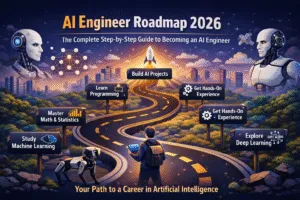
Here is a structured, stage-by-stage roadmap to building the exact skills employers are looking for. Think of this as your curriculum — broken into digestible layers you can learn sequentially.
Stage 1: Learn Python (the non-negotiable foundation)
You do not need to be a Python wizard. You need to be functional. LLM engineering uses Python heavily, but in a very applied way — calling APIs, parsing responses, managing data, writing scripts. You are not building operating systems.
What to focus on: variables and data types, functions, loops, dictionaries and lists, working with JSON, reading and writing files, using third-party libraries with pip, and basic error handling. Tools like Automate the Boring Stuff with Python (free online) and Python.org documentation are excellent starting points. Give yourself 4 to 6 weeks of daily practice.
Stage 2: APIs and HTTP — how to talk to AI models
Every LLM you will work with exposes its capabilities through an API (Application Programming Interface). Understanding how to make API calls, handle authentication, parse responses, and manage rate limits is core to the job.
Start with the OpenAI API. Read the official docs, make your first completion call, and experiment with different parameters like temperature, max tokens, and system prompts. Then explore the Anthropic API and Google Gemini API. Learn what REST APIs are, how to use the requests library in Python, and how to store API keys securely using environment variables.
Stage 3: Prompt engineering — the art and science of talking to LLMs
Prompt engineering is the practice of designing inputs to AI models to reliably produce desired outputs. It sounds simple, but mastering it is genuinely valuable and currently one of the most in-demand skills in AI product teams.
Learn the core techniques: zero-shot prompting, few-shot prompting, chain-of-thought reasoning, role prompting, and output formatting constraints. Then go deeper into system prompt design, handling edge cases, and building prompt templates that are reusable and maintainable. OpenAI has excellent prompting guides, and Anthropic’s prompt engineering documentation is exceptional.
Stage 4: Retrieval-Augmented Generation (RAG)
RAG is one of the most important architectures in production LLM applications. The idea is simple: instead of relying on what an LLM knows from training, you give it access to a knowledge base at runtime. This solves the hallucination problem and keeps responses grounded in your data.
To build RAG systems, you need to understand vector embeddings (how text is converted to numbers that capture meaning), vector databases like Pinecone, Weaviate, or Chroma, and retrieval logic that fetches relevant context before passing it to the LLM. LangChain and LlamaIndex are the two most popular frameworks for building RAG pipelines, and both have strong documentation and tutorials.
Stage 5: Fine-tuning — teaching models new tricks
Fine-tuning is the process of taking a pre-trained model and training it further on domain-specific data so it performs better on your specific tasks. You do not always need to fine-tune, but knowing when and how to is a key differentiator.
Start with OpenAI’s fine-tuning API, which lets you fine-tune GPT models on your own data with relatively little friction. Then learn about parameter-efficient fine-tuning methods like LoRA (Low-Rank Adaptation), which allow you to fine-tune large open-source models without needing a supercomputer. Hugging Face’s PEFT library is the industry standard here.
Stage 6: Deployment and MLOps basics
Building a great LLM application means nothing if it cannot run reliably in production. This stage covers how to deploy and serve your AI applications.
Learn to containerize applications with Docker, deploy to cloud platforms like AWS, Google Cloud, or Azure, and build simple REST APIs that wrap your LLM logic using FastAPI or Flask. Understand concepts like environment management, logging, monitoring model performance, and handling API costs. Tools like LangSmith and Weights & Biases are helpful for observability.
Not sure where to start with all these skills? You do not have to figure it out alone.
Everyone Who Codes offers structured learning paths, free FAANG interview preparation materials, and a blog full of career insights written for real people making real career transitions.
Get your free ATS-compliant resume, explore community resources, and start building confidence with expert-backed materials.
Free Resources: https://everyonewhocode.com/free-faang-interview-preparation/
Explore Blogs: https://everyonewhocode.com/blogs/
Access free resources at Everyone Who Codes
Building a portfolio that proves your LLM engineer skills
Certifications and courses matter, but your GitHub portfolio is what will actually get you interviews when you do not have a CS degree. Hiring managers want to see that you can build real things.

Project ideas to build as an LLM engineer without a degree
1. A RAG-powered document Q&A tool
Build an app where users upload a PDF and ask questions about it. This showcases your understanding of embeddings, vector search, and LLM orchestration. It is a direct demo of production-relevant architecture.
2. A custom AI chatbot with memory
Build a chatbot that maintains conversation history and can be configured with a custom system prompt for a specific use case (legal Q&A, cooking assistant, HR FAQ bot). Use LangChain’s memory module or implement your own context window management.
3. An AI agent that uses tools
Build an agent that can search the web, run code, or call external APIs using LangChain or the OpenAI function calling API. Agents that can autonomously complete multi-step tasks are the frontier of LLM applications right now.
4. A fine-tuned model for a niche task
Fine-tune a small open-source model (like Mistral 7B) on a specific dataset — customer support conversations, medical FAQs, legal document summarization. Upload it to Hugging Face and document the process in a detailed README.
How to document your LLM projects on GitHub
- Write a clear README that explains what the project does, why it exists, and how to run it.
- Include architecture diagrams showing how data flows through your system.
- Document your design decisions — why you chose one vector database over another, why you structured prompts a certain way.
- Record a short demo video and link it in the README. This is often the difference between someone clicking through and someone bouncing.
Certifications worth getting as an LLM engineer without a CS degree
While experience and projects outweigh certifications, the right credentials can validate your skills and give hiring managers confidence, especially early in your career switch.

Top certifications for aspiring LLM engineers
- DeepLearning.AI Short Courses — Andrew Ng’s team offers practical, application-focused courses on LLMOps, RAG, prompt engineering, and fine-tuning. These are widely recognized and typically completable in a few hours each.
- Google Cloud Professional Machine Learning Engineer — A more comprehensive certification that signals real production readiness. Takes more preparation but carries significant weight.
- AWS Certified Machine Learning Specialty — Valuable if you are targeting companies heavily invested in the AWS ecosystem.
The most credible certification strategy is to complete 2 to 3 focused, practical certifications and pair them with a strong project portfolio, rather than collecting credentials without the hands-on evidence.

Mock interview: common LLM engineer interview questions
Getting ready for interviews as someone without a traditional CS background requires deliberate preparation. Here are the types of questions you should be ready to answer, with guidance on what strong answers look like.
Technical interview questions
Q: Explain how RAG works and when you would use it.
Strong answer: RAG stands for Retrieval-Augmented Generation. When a user asks a question, the system first retrieves relevant documents from a vector database using semantic similarity search, then injects those documents as context into the LLM prompt before generating a response. You would use RAG when you need the model to answer questions grounded in specific, current, or proprietary data that was not in the model’s training data.
Q: What is the difference between fine-tuning and prompt engineering?
Strong answer: Prompt engineering changes the model’s behavior at inference time by crafting better inputs. Fine-tuning changes the model’s weights by training it on new data. Prompt engineering is faster and cheaper; fine-tuning is better for consistent behavior on specialized tasks or for teaching the model a specific style or format it struggles to learn through prompting alone.
Q: How do you handle hallucinations in production LLM applications?
Strong answer: A combination of strategies works best. RAG grounds responses in retrieved facts. Output parsing and validation catches responses that do not conform to expected formats. Confidence scoring or self-consistency checks (asking the model the same question multiple ways and comparing answers) can flag uncertain responses. For high-stakes domains, adding a human review step is often essential.
Behavioral interview questions for LLM engineers
Q: Tell me about a project where you had to iterate on your approach.
Use your portfolio projects here. Talk about a specific technical challenge you encountered, the decision you made, and what you learned. Interviewers are looking for problem-solving mindset and intellectual honesty about failure.
Q: How do you stay current in AI, given how fast the field moves?
Strong candidates mention specific sources: Papers With Code, Hugging Face blog, Towards Data Science, the Anthropic and OpenAI research blogs, specific newsletters like The Batch, and participation in communities like AI Discord servers or local meetups.
How to land an LLM engineer job in 90 days: your action plan
This is not a vague motivational plan. This is a week-by-week structure you can actually follow.
Days 1 to 30: build the foundation
- Complete a focused Python course (Python for Everybody on Coursera is a strong choice).
- Set up your development environment: VS Code, Python 3.10+, virtual environments, Git.
- Make your first OpenAI API call. Build a simple question-answer script.
- Create your GitHub profile with a professional README.
- Start following AI practitioners on LinkedIn and X (formerly Twitter).
Days 31 to 60: build your first 2 portfolio projects
- Build a RAG application using LangChain + Chroma or Pinecone. Document everything in your GitHub README.
- Build a second project showing a different skill set: an AI agent, a fine-tuned model, or a deployed chatbot with a simple front end.
- Enroll in and complete one DeepLearning.AI short course relevant to your projects.
- Begin connecting with LLM engineers and AI hiring managers on LinkedIn. Personalize every connection request.
Days 61 to 90: apply and interview
- Polish your resume with ATS-compliant formatting (more on this below).
- Apply to 5 to 10 targeted roles per week — quality over quantity.
- Do mock technical interviews with peers or a mentor. Practice explaining your projects clearly and concisely.
- Engage in public learning: write a LinkedIn post about something you built, contribute to an open-source LLM project, or answer questions on Stack Overflow.
- Follow up consistently on every application after 5 to 7 business days.
Get a free ATS-compliant resume for your LLM engineer job search
One of the most overlooked obstacles for career switchers is the Applicant Tracking System (ATS). These systems scan resumes for relevant keywords before a human ever sees your application. A poorly formatted resume, even with great content, gets filtered out automatically.
An ATS-compliant resume for an LLM engineer role should include keywords like Python, LangChain, RAG, vector databases, OpenAI API, Hugging Face, fine-tuning, LLM, NLP, model deployment, FastAPI, and Docker. Formatting matters too: no tables, no images, no columns, no fancy fonts. Clean, single-column, keyword-rich, and achievement-focused.
Get your free ATS-compliant resume reviewed at Everyone Who Codes.
The team at Everyone Who Codes helps career switchers and tech professionals craft resumes that actually pass ATS filters and impress human recruiters.
Do not let formatting mistakes cost you interviews you deserve.
Visit: https://everyonewhocode.com/blogs/
Get resume help at Everyone Who Codes
What LLM engineers earn and what to expect in your first role
LLM engineering is one of the most compensated roles in tech right now. Entry-level LLM engineer roles at startups typically start between $90,000 and $130,000 annually in the United States, while mid-level roles at larger companies often range from $140,000 to $200,000 or more, with equity on top.
In global markets including India, Southeast Asia, and parts of Europe, the compensation is lower in absolute terms but the demand is growing rapidly as companies build regional AI teams. Remote roles — especially for engineers with strong portfolios — are widely available and often come with competitive international compensation.
Your first role may be titled AI Engineer, Prompt Engineer, ML Engineer, or LLM Developer depending on the company. Do not let titles confuse you — look at the actual job description and required skills to understand what the role involves.

Common mistakes to avoid on your path to becoming an LLM engineer
Waiting until you feel ‘ready’
The field moves faster than any curriculum. Start building projects before you feel fully prepared. Imperfect projects that exist beat perfect projects that live in your head.
Skipping the fundamentals of Python
Some learners jump straight to frameworks like LangChain without understanding Python fundamentals. This creates a fragile knowledge base. Spend the time to learn Python properly — it pays dividends in debugging and understanding documentation.
Building projects with no documentation
A GitHub repository with no README is nearly invisible to hiring managers. Every project needs clear documentation. Treat your README like a product page — what does this do, why does it exist, how do you run it, what did you learn building it.
Networking passively
Following people on LinkedIn is not networking. Direct outreach, genuine engagement with content, asking specific questions in communities, and sharing your own learning publicly are what actually build professional relationships in this industry.
Ready to accelerate your path? Book a 1:1 mentorship session
Navigating a career switch into LLM engineering can feel overwhelming, especially when you are doing it without a traditional background or a built-in network. That is exactly where structured mentorship makes a measurable difference.
Whether you are trying to figure out where to start, need feedback on your portfolio, want to prepare for technical interviews, or simply need someone who has been through this to tell you what actually matters — a 1:1 mentorship session can compress months of trial and error into a single focused conversation.
Book your 1:1 tech mentorship session at Everyone Who Codes.
The mentors at Everyone Who Codes are practitioners with real industry experience who have helped hundreds of career switchers land roles in AI, ML, and software engineering.
Stop guessing. Start building with guidance from someone who knows the path.
Why Everyone Who Codes? Because they specialize in exactly this kind of transition — helping people without traditional degrees break into tech through skills, community, and structured support.
Book 1:1 Mentorship: https://everyonewhocode.com/services/1-1-tech-mentorship/
Book your 1:1 mentorship session now
Stay updated with real insights on tech careers, interviews, hiring trends, and career growth
📩 Subscribe to our Substack
📌 Follow our LinkedIn Newsletter
🎥 Subscribe to our YouTube Channel for more career tips and interview guidance
Conclusion: your LLM engineer journey starts today
The path to becoming an LLM engineer without a computer science degree is not a shortcut — it is a different path, one that requires discipline, curiosity, and a willingness to build in public before you feel fully ready. But the destination is absolutely reachable.
You have now seen the complete roadmap: Python fundamentals, API fluency, prompt engineering mastery, RAG architecture, fine-tuning, deployment, portfolio development, certifications, interview preparation, and a 90-day action plan. Every one of these skills is learnable online, often for free, with the right structure and commitment.
The AI industry does not care where your degree is from. It cares what you can build. So start building. Document everything. Share your progress. And when you need guidance, reach out to a community that is built for exactly this kind of journey.
Your career in LLM engineering is not waiting on a degree. It is waiting on you.
Join Everyone Who Codes — your community for breaking into AI and tech.
This is not just a website. It is a community that invests in your growth.
Website: https://everyonewhocode.com/
1:1 Mentorship: https://everyonewhocode.com/services/1-1-tech-mentorship/
Free Resources: https://everyonewhocode.com/free-faang-interview-preparation/
Blogs: https://everyonewhocode.com/blogs/
📩 Subscribe to our Substack
📌 Follow our LinkedIn Newsletter
🎥 Subscribe to our YouTube Channel for more career tips and interview guidance

How to become an LLM engineer without a Computer Science Degree: FAQs
1. Do I need a computer science degree to become an LLM engineer?
No. The blog makes it clear that employers care more about your skills, portfolio, and ability to build real applications than formal education.
2. What exactly does an LLM engineer do?
An LLM engineer builds and deploys applications using large language models like GPT, focusing on prompting, RAG systems, fine-tuning, and APIs rather than training models from scratch.
3. What programming language should I learn first?
Python is essential. You don’t need to master advanced concepts—just be comfortable with APIs, data handling, and scripting.
4. How long does it take to become job-ready?
With consistent effort, you can become job-ready in around 90 days by following a structured plan that includes learning, building projects, and applying.
5. What are the most important skills for LLM engineers?
- Key skills include:
- Python basics
- API usage
- Prompt engineering
- Retrieval-Augmented Generation (RAG)
- Fine-tuning
- Deployment & MLOps basics
6. What is RAG and why is it important?
RAG (Retrieval-Augmented Generation) allows LLMs to use external data sources in real time, reducing hallucinations and improving accuracy in production systems.
7. Do I need certifications to get hired?
Certifications help, but they are secondary. A strong GitHub portfolio with real projects matters far more to hiring managers.
8. What kind of projects should I build?
- Good portfolio projects include:
- A document Q&A app (RAG-based)
- A chatbot with memory
- AI agents that use tools
- A fine-tuned model for a niche use case
9. How much do LLM engineers earn?
Entry-level roles can start around $90,000–$130,000 (US), with higher ranges for experienced roles. Global salaries vary but demand is growing rapidly.
10. What is the biggest mistake beginners make?
- Common mistakes include:
- Waiting until they feel “ready”
- Skipping Python fundamentals
- Not documenting projects
- Passive networking instead of active engagement
11. Where can I get structured guidance and mentorship?
Platforms like Everyone Who Codes offer mentorship, learning paths, and career support specifically for people transitioning into AI without traditional backgrounds.
📩 Subscribe to our Substack
📌 Follow our LinkedIn Newsletter
🎥 Subscribe to our YouTube Channel for more career tips and interview guidance