Skip to content
Why most engineers fail interviews even when they are technically strong has become one of the most quietly painful realities in the modern tech industry. Engineers with years of production experience, strong performance reviews, and real ownership of complex systems often find themselves repeatedly rejected in interviews they genuinely expected to pass. The disconnect is deeply confusing. When nothing has changed about your competence, yet outcomes keep worsening, self-doubt creeps in fast.
This confusion persists because interviews feel like they should reward experience. In reality, interviews reward something else entirely. They are not designed to reflect real engineering environments. Instead, they test a compressed, artificial version of problem-solving under time pressure, observation, and incomplete context. Engineers who don’t recognize this distinction often walk into interviews underprepared not because they lack skill, but because they misunderstand what is being evaluated. This growing realization is why many engineers now seek more structured interview preparation approaches through platforms like https://everyonewhocode.com/, rather than relying on experience alone.
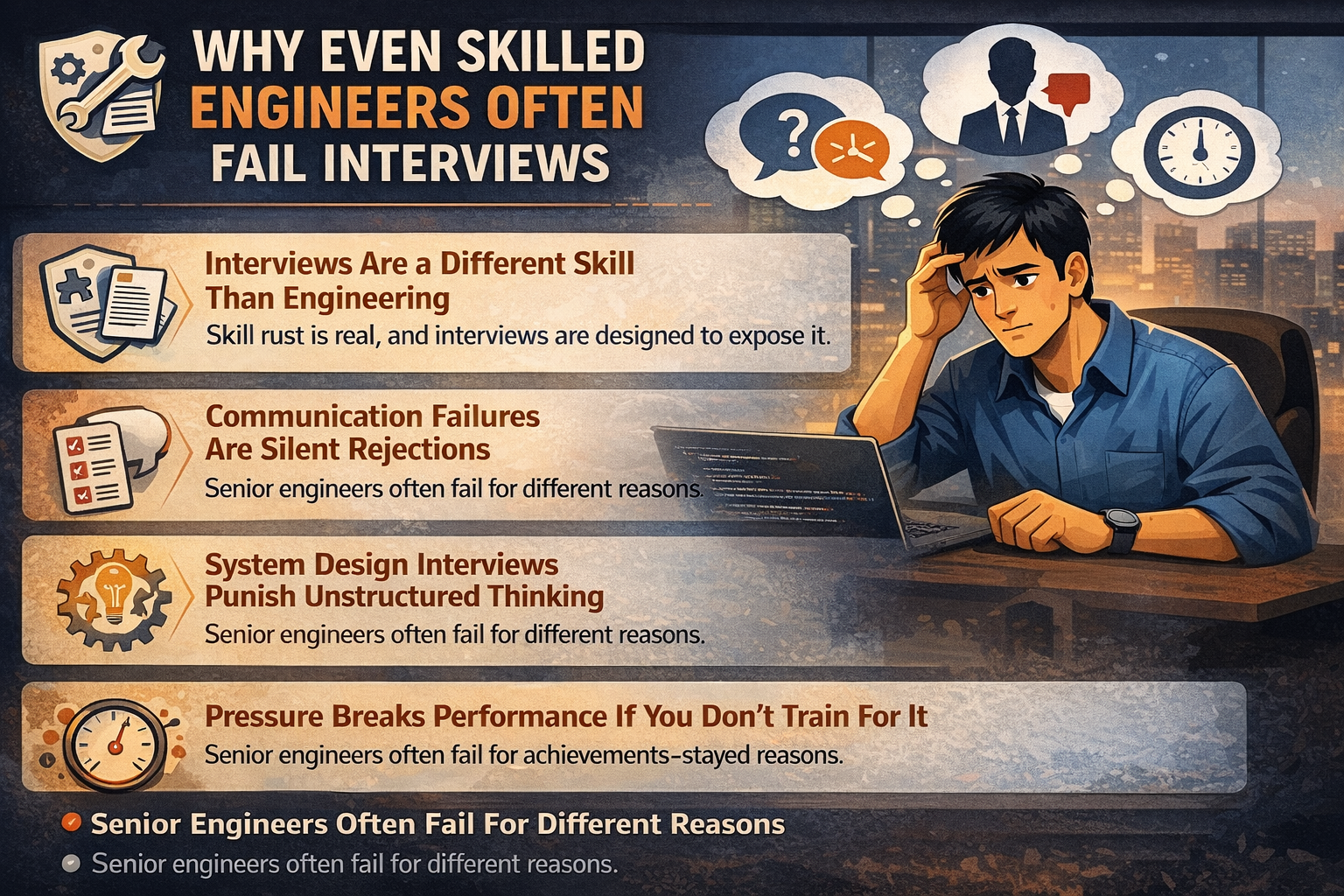
Interviews are a different skill than engineering
At the core of why most engineers fail interviews even when they are technically strong is a fundamental misunderstanding of interviews themselves. Real engineering work is collaborative, iterative, and contextual. Engineers have access to documentation, teammates, tools, prior decisions, and time. Interviews deliberately remove all of these advantages.
In an interview, candidates are expected to reason out loud, recall concepts instantly, and produce structured solutions while being evaluated in real time. These conditions do not resemble day-to-day engineering work, yet they dominate hiring decisions. The mistake many engineers make is assuming that being good at their job automatically translates into interview performance.
Interviewing is a performance skill. Like public speaking or competitive programming, it requires deliberate practice in a specific environment. Engineers who study interview mechanics, common evaluation signals, and structured problem-solving patterns often through detailed breakdowns and preparation guidance found in our mock interview like https://everyonewhocode.com/services/mock-interviews/ consistently outperform equally capable peers who rely on intuition alone.
Skill rust is real, and interviews are designed to expose it
Another major reason why most engineers fail interviews even when theyare technically strong is skill rust. Once engineers enter full-time roles, they stop solving problems from scratch. Their work becomes focused on maintaining existing systems, shipping features, debugging production issues, and navigating established architectures.
As a result, foundational algorithmic skills fade not because engineers are incapable, but because they are unused. Interviews, however, demand instant recall. When an interviewer asks for a depth-first traversal or optimal space complexity, hesitation is interpreted as weakness.
This mismatch creates a misleading signal. Knowledge often still exists, but it’s buried under years of disuse. Engineers who proactively refresh these skills through intentional, structured practice close this gap quickly. This is why preparation ecosystems like https://everyonewhocode.com/ emphasize consistency and pattern recognition rather than random grinding.
Communication failures are silent rejections
One of the most underestimated contributors to why most engineers fail interviews even when they are technically strong is communication. Many engineers solve problems internally but fail to articulate their thinking clearly. In interviews, silence is rarely neutral, it is interpreted as confusion, uncertainty, or lack of structure.
Interviewers are not evaluating only correctness. They are evaluating reasoning, decision-making, and clarity. Strong candidates narrate assumptions, explain tradeoffs, and guide the interviewer through their thinking step by step. Engineers who skip this appear weaker, even if they arrive at correct solutions.
This gap is especially pronounced among engineers who work independently or in environments where verbal problem-solving is rare. Practicing explanation often by following interview-style walkthroughs and structured examples like those discussed on https://everyonewhocode.com/blogs/ dramatically improves interview outcomes without changing underlying technical ability.
Senior engineers often fail for different reasons
Why most engineers fail interviews even when they are technically strong becomes particularly painful at senior levels. Experienced engineers often assume their background will speak for itself. Instead, they over-optimize too early jumping into advanced architectures, edge cases, or buzzwords before establishing a clear baseline.
Interviewers aren’t looking for maximal complexity. They are looking for judgment. Senior candidates are expected to clarify requirements, justify tradeoffs, and demonstrate restraint. When they rush or overcomplicate, they can appear scattered or arrogant, even when their intent is to demonstrate expertise.
This mismatch between intention and perception is why many senior engineers are rejected unexpectedly. Engineers who receive direct feedback on this behavior often through personalized preparation and targeted coaching such as 1-1-Tech-Mentorship and Mock Interviews through Everyone Who Codes tend to correct it far faster than those practicing alone.
System design interviews punish unstructured thinking
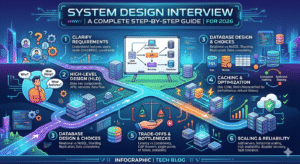
System design rounds are where why most engineers fail interviews even when they are technically strong becomes most visible. Engineers with real system experience often assume that experience alone will carry them. Instead, they dive straight into tools, databases, and architectures without framing the problem.
Interviewers want to see how candidates handle ambiguity. They look for requirement gathering, constraint identification, prioritization, and tradeoff reasoning. Without a repeatable framework, even experienced engineers appear lost.
The paradox is that real-world experience can actually hurt performance if it isn’t structured. Engineers who learn clear system design frameworks and practice applying them under interview conditions consistently outperform those relying purely on intuition. Many engineers discover these frameworks through structured learning paths and long-form explanations available via Mastering-System-Design/.
Pressure breaks performance if you don’t train for it
Another uncomfortable truth behind why most engineers fails interviews even when they’re technically strong is pressure. Interviews combine time limits, unfamiliar environments, judgment, and stakes all of which degrade cognitive performance.
Engineers who have never practiced under these conditions often freeze, make simple mistakes, or panic when stuck. This leads to a dangerous feedback loop: anxiety causes underperformance, which reinforces self-doubt, which worsens future performance.
Pressure handling is not a personality trait. It is a trained response. Engineers who simulate interviews repeatedly learn to stay calm, recover from mistakes, and keep moving forward. Those who don’t often mistake anxiety for inability, leaving interviews believing they are worse engineers than they actually are.
Why this problem is getting worse, not better
Why most engineers fail interviews even when they’re technically strong is becoming more common as the market changes. Hiring bars are higher, interview loops are longer, and competition is global. Companies increasingly prefer false negatives over false positives.
In this environment, experience alone no longer guarantees success. Engineers who wait until they urgently need a job to prepare often face higher anxiety and lower confidence. Those who treat interview readiness as an ongoing skill supported by structured resources and deliberate practice through platforms like https://everyonewhocode.com/ retain far more control over their careers.
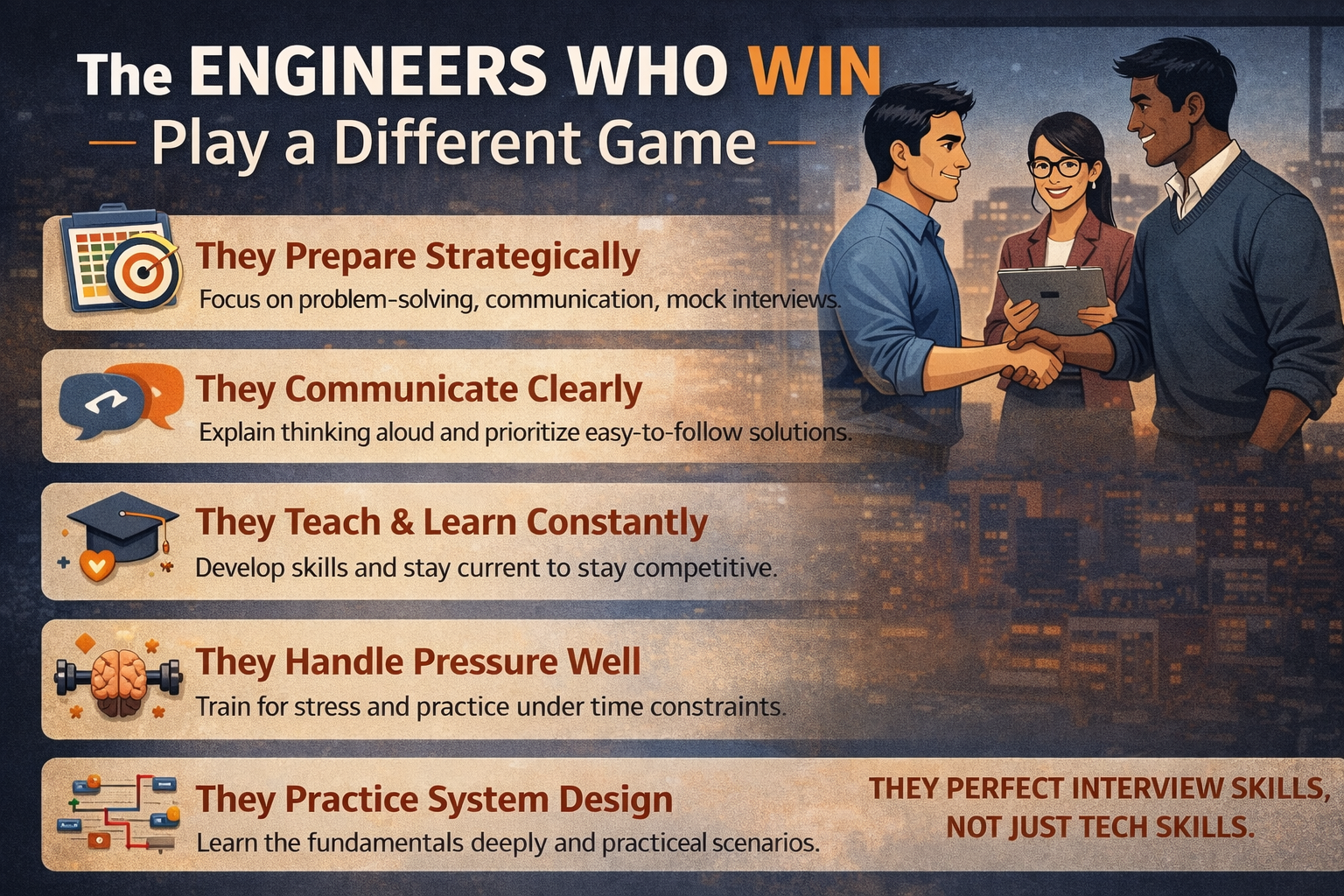
Top performers focus on interview skills, not just technical ability.
The Engineers who win play a different game
The engineers who overcome why most engineers fail interviews even when they are technically strong are not necessarily smarter or more experienced. They simply understand how interviews work. They prepare deliberately, communicate clearly, and rely on structure rather than improvisation.
They know interviews don’t define their worth, but they do determine access to opportunities. By following structured preparation strategies, learning from detailed interview analyses available on https://everyonewhocode.com/blogs/, and seeking personalized feedback when necessary through https://everyonewhocode.com/services/1-1-tech-mentorship/, & Mock Interviews through FAANG engineers dramatically improve their odds.
Interview success is not a mystery. It’s a skill. With the right approach, preparation, and mindset, why most engineers fail interviews even when they’re technically strong does not have to be your story—it becomes a problem you know how to solve.

Frequently asked questions (faqs)
Why do technically strong engineers fail interviews so often?
Technically strong engineers often fail interviews because interviews evaluate a different skill set than day-to-day engineering work. Interviews prioritize structured thinking, clear communication, and performance under pressure. Engineers who haven’t practiced specifically for this environment may underperform despite being highly capable in real-world roles.
Is failing interviews a sign that I am a bad engineer?
No. Failing interviews is not an indicator of engineering ability or professional value. Many excellent engineers struggle because interview skills decay over time and require deliberate practice. Interview performance and job performance are related but distinct competencies.
Why do interviews focus so heavily on algorithms and system design?
Algorithms and system design are used as proxies to evaluate reasoning, abstraction, and decision-making under constraints. While these skills may not reflect daily work for many engineers, they provide interviewers with a standardized way to compare candidates. This mismatch is a major reason why interview outcomes often feel disconnected from real-world experience.
How long does it take to improve interview performance?
Most engineers see meaningful improvement within a few weeks to a few months with focused, structured practice. Progress depends on consistency, feedback, and practicing under interview-like conditions rather than passive learning or random problem-solving.
Can experience alone help me pass interviews without preparation?
In today’s market, experience alone is rarely sufficient. One of the most common mistakes engineers make is assuming that years of work will compensate for a lack of interview-specific preparation. Engineers who pair experience with deliberate practice often using structured learning paths such as those found on https://everyonewhocode.com/ perform significantly better.
Why do senior engineers still fail interviews?
Senior engineers often fail because they over-optimize too early, skip requirement clarification, or introduce unnecessary complexity. Interviews at senior levels emphasize judgment, structure, and tradeoff reasoning. Without adapting communication style to interview expectations, even highly experienced engineers can appear unfocused.
What is the biggest mistake engineers make during system design interviews?
The biggest mistake is starting with tools and technologies instead of problem framing. Interviewers want to see how candidates handle ambiguity, define requirements, and reason through tradeoffs. Engineers who follow a clear, repeatable framework often learned through detailed interview breakdowns and examples like those discussed on https://everyonewhocode.com/blogs/ consistently perform better.
How important is communication compared to correctness?
Communication is often more important than correctness. Interviewers evaluate how candidates think, not just what answer they reach. Clear explanations, structured reasoning, and verbalizing assumptions can outweigh minor implementation mistakes.
Do interviews define my value as an engineer?
No. Interviews do not define an engineer’s worth or long-term potential. They are imperfect filters used to manage hiring risk. Understanding this distinction helps engineers approach interviews with confidence rather than fear and reduces the emotional toll of rejection.
What is the most effective way to prepare for interviews?
The most effective preparation combines deliberate practice, pattern recognition, communication training, and structured frameworks especially for system design. Practicing under realistic conditions and receiving feedback dramatically increases success compared to passive learning or last-minute cramming.
Everyone Who Codes offers 1:1 guidance to help you land tech interviews and convert them into job offers.
👉 Book your 1:1 consultation with Everyone Who Codes and start landing job offers with clarity.