Skip to content
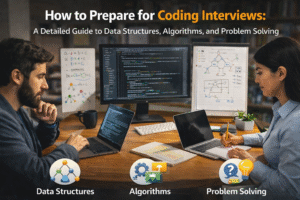
Cracking coding interviews is one of the most important steps in building a successful software engineering career. Whether you are a college student, a fresher, or an experienced developer preparing for a job switch, coding interviews often feel intimidating and unpredictable.
Many candidates believe that only “naturally smart” people crack coding interviews. That belief is incorrect. Coding interviews are not about raw intelligence. They are about structured thinking, preparation, and communication. With the right approach, anyone can significantly improve their performance.
This guide explains how to crack coding interviews step by step, using proven preparation frameworks, interviewer insights, and common mistakes to avoid. The explanations are practical, easy to understand, and designed to help you perform confidently in real interviews.
What is a coding interview?
A coding interview is a technical interview round where companies evaluate your ability to solve programming problems under time constraints. The goal is not just to see whether you can write code, but whether you can think like a software engineer.
Most coding interviews last between 30 and 45 minutes. During this time, you are usually given one main problem and sometimes one or more follow-up questions. You are expected to understand the problem, design an approach, write working code, and explain your reasoning clearly.
Coding interviews usually focus on data structures, algorithms, and problem-solving skills. For mid-level and senior roles, they may also include system design, but strong fundamentals are always required.
If you’re preparing for coding interviews, you can get personalized support through 1:1 tech mentorship at Everyone Who Codes. Their mentorship sessions focus on data structures, algorithms, system design, and real interview practice to help you build confidence and improve problem-solving skills. You can book a dedicated 1:1 session here: https://everyonewhocode.com/services/1-1-tech-mentorship/. Learn more about their overall interview preparation and mentorship offerings on their official website: https://everyonewhocode.com/.
Why coding interviews feel difficult?
Coding interviews feel hard because they test multiple skills at the same time. You are expected to think logically, code correctly, communicate clearly, and manage time all while being observed.
Another reason interviews feel difficult is that many candidates prepare in an unstructured way. They solve random problems without understanding patterns, memorize solutions instead of concepts, or focus only on coding and ignore communication.
The pressure of a live interview environment can also affect performance. Even strong developers may struggle if they are not used to explaining their thoughts out loud or coding under time limits.
The good news is that these challenges are common, and they can be overcome with the right preparation strategy.
How do interviewers evaluate candidates?
To crack coding interviews, you must understand how interviewers think. Most companies evaluate candidates using similar criteria, even if the exact scoring system differs.
Interviewers usually assess problem-solving ability first. They want to see whether you can understand the problem quickly, ask the right questions, and break it down logically. They are interested in how you approach the problem, not just the final answer.
Data structures and algorithms knowledge is another major factor. Interviewers look for appropriate choices, such as using a hash map instead of nested loops or applying binary search when the input is sorted. They also expect you to understand time and space complexity.
Coding quality matters as well. Clean, readable code with meaningful variable names creates a strong impression. Small mistakes are acceptable, but messy or confusing code is a red flag.
Finally, communication plays a critical role. Candidates who explain their thinking clearly, respond well to hints, and collaborate with the interviewer often perform better than silent candidates with perfect logic.
The right mindset for coding interviews
Before discussing preparation, it is important to adopt the right mindset. Coding interviews are not exams. They are collaborative problem-solving sessions.
Interviewers are not trying to trick you. They want to see whether you can work through problems logically and communicate effectively. If you make a mistake but explain your reasoning well and correct yourself, that is often seen as a positive signal.
You should also remember that optimization is not always required immediately. Interviewers prefer a correct and clear solution first, followed by improvements if time allows.
Approaching interviews with curiosity instead of fear can significantly improve your performance.
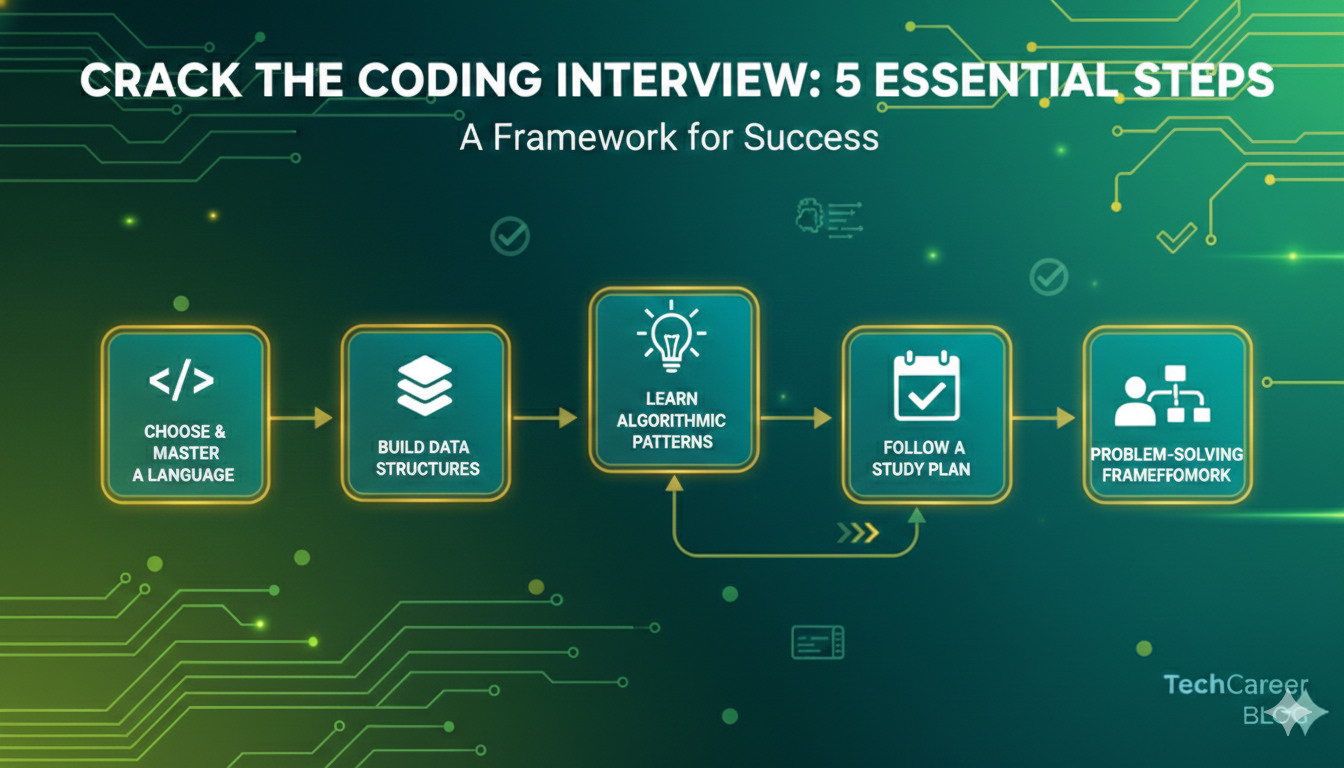
Step 1: Choose one programming language and master it
One of the most common mistakes candidates make is switching programming languages during preparation. This leads to confusion and slows down coding speed.
You should choose one primary language and use it consistently. Python, Java, C++, and JavaScript are all widely accepted in interviews. The best language is the one you are most comfortable with and can write quickly without thinking about syntax.
Once you choose a language, make sure you understand its standard libraries, data structures, and common operations. Knowing how arrays, maps, sets, and strings behave in your chosen language will save valuable time during interviews.
Step 2: Build strong foundations in data structures
Data structures are the backbone of coding interviews. You do not need to learn everything, but you must be strong in the most commonly tested structures.
Arrays and strings appear in almost every interview. You should be comfortable with indexing, iteration, slicing, and common operations. Hash maps are equally important, as they help optimize time complexity in many problems.
Linked lists, stacks, and queues are also frequently tested. You should understand how they work and when to use them. Trees, especially binary trees and binary search trees, are very common and require practice to visualize and traverse correctly.
Graphs, heaps, and tries appear less frequently but are still important for certain roles and companies. Focus on understanding basic traversal techniques and use cases.
Step 3: Learn algorithmic patterns instead of memorizing problems
One of the most effective ways to crack coding interviews is to learn algorithmic patterns. Most interview problems are variations of a small number of core patterns.
For example, many array problems can be solved using the two-pointer or sliding window technique. Problems involving searching often use binary search. Tree and graph problems usually involve depth-first search or breadth-first search.
Dynamic programming problems may look complex at first, but they often follow recognizable patterns once you understand how to break problems into subproblems.
By focusing on patterns, you train your brain to recognize solutions quickly, even when the problem looks unfamiliar.
Step 4: Follow a structured study plan
Random practice leads to slow progress. A structured study plan helps you build skills systematically and avoid burnout.
A realistic preparation timeline is eight to twelve weeks, with two to three hours of focused study per day. During each week, focus on one or two topics. Start by understanding the concept, then solve related problems, and finally review your mistakes.
Consistency is more important than long study sessions. Regular practice builds confidence and muscle memory, which are critical during interviews.
Step 5: A framework for solving problems in interviews
Having a clear framework helps you stay calm and organized during interviews.
Start by clarifying the problem. Ask about input format, constraints, and edge cases. This shows attention to detail and prevents misunderstandings.
Next, think out loud. Explain your initial thoughts and mention a simple or naive approach if one exists. This reassures the interviewer that you understand the problem.
Then propose an optimized solution. Describe the algorithm in words and analyze its time and space complexity. Once the interviewer agrees, start coding.
While coding, write clean and readable code. After finishing, test your solution with sample inputs and edge cases. This final step often catches small bugs and leaves a strong impression.
How many problems should you practice?
There is no magic number, but most successful candidates solve between 150 and 300 problems, depending on their experience level.
The goal is not to solve as many problems as possible, but to deeply understand patterns and improve problem-solving speed. Revisiting problems and learning from mistakes is more valuable than rushing through new ones.
The importance of mock interviews
Mock interviews are one of the most overlooked aspects of preparation. Many candidates feel confident while practicing alone but struggle in real interviews.
Mock interviews simulate real pressure and help you practice explaining your thoughts clearly. They also reveal weaknesses that are hard to notice during solo practice.
Doing three to five mock interviews before real interviews can significantly boost confidence and performance.
Yes. Mock interviews simulate real interview conditions, improve communication and time management, and significantly reduce anxiety during actual coding interviews.
Real Mock Interviews with Expert FAANG Engineers – Mock Interviews – Everyone Who Codes
Common coding interview mistakes
Many candidates fail interviews not because they lack knowledge, but because they repeat common mistakes.
One frequent mistake is jumping straight into coding without fully understanding the problem. This often leads to incorrect assumptions and wasted time.
Another mistake is staying silent. Interviewers cannot evaluate your thinking if you do not explain it. Silence is often interpreted as confusion.
Ignoring edge cases, over-optimizing too early, and writing messy code are also common issues. Poor time management, such as spending too long on one idea, can prevent you from completing the problem.
Being aware of these mistakes helps you avoid them.
What to do when you get stuck
Getting stuck is normal, even for strong candidates. What matters is how you handle it.
When stuck, explain what you are thinking and where you are unsure. Re-read the problem, simplify it, or consider a brute-force approach. Interviewers often provide hints, and accepting them gracefully is a positive signal.
Staying calm and adaptable is more important than finding the solution instantly.
Final week preparation strategy
In the final week before interviews, focus on revision rather than learning new topics. Review common patterns, revisit weak areas, and practice explaining solutions clearly.
Avoid last-minute cramming. Get enough sleep, stay hydrated, and maintain a calm mindset. Confidence plays a significant role in interview performance.
Yes. Mock interviews simulate real interview conditions, improve communication and time management, and significantly reduce anxiety during actual coding interviews.
Want a personalized plan to land interviews and clear them to land job offers?
If you want a structured roadmap, real feedback, and mentorship from FAANG engineers, here is how we can help:
- Career Guidance Program (to get interview calls) – Resume review & job search tips – Everyone Who Codes
• 1:1 DSA / System Design / Interview Mentorship to clear interviews – 1 : 1 Tech Mentorship – Everyone Who Codes - Real Mock Interviews with Expert FAANG Engineers – Mock Interviews – Everyone Who Codes
Frequently Asked Questions (FAQ)
How long does it take to crack coding interviews?
For most candidates, it takes between two and three months of consistent preparation. Beginners may need more time, while experienced developers may need less.
Is LeetCode enough for coding interview preparation?
LeetCode is a useful tool, but it is not enough by itself. You must also focus on understanding patterns, practicing communication, and doing mock interviews.
Do I need to solve hard problems to pass interviews?
Most interviews focus on easy to medium problems with follow-ups. Solving hard problems can help, but strong fundamentals matter more.
What if I fail a coding interview?
Failing an interview is common and does not define your ability. Use it as feedback, identify gaps, and improve for the next opportunity.
Can non-CS students crack coding interviews?
Yes. Many successful engineers come from non-CS backgrounds. Structured preparation and consistent practice matter more than formal education.
Final thoughts
Cracking coding interviews is not about luck or memorization. It is about preparation, structure, and mindset. By understanding how interviews work, learning core patterns, practicing consistently, and avoiding common mistakes, you can dramatically improve your chances of success.
Coding interviews reward candidates who think clearly, communicate well, and stay calm under pressure. With the right strategy, you can absolutely crack them.
Get personalized help to crack your coding interviews
Reading guides and practicing problems is important, but personalized guidance is what truly accelerates results. Every candidate has different strengths, weaknesses, and career goals. A one-size-fits-all approach often leaves gaps that show up during real interviews.
At Everyone Who Codes, we help candidates prepare smarter—not harder—by focusing on exactly what interviewers look for and what you need to improve.
If you are serious about cracking coding interviews, getting feedback from experienced mentors can make a massive difference.
What You Get with a 1:1 Mentorship Session
A 1:1 session is designed to give you clear direction and actionable feedback, not generic advice. During the session, you can expect:
- A personalized assessment of your current interview readiness
- Guidance on which data structures and patterns you should prioritize
- Feedback on your problem-solving and communication approach
- Mock interview–style discussion with real-time insights
- A clear preparation roadmap tailored to your goals (FAANG, startups, or product companies)
Whether you are struggling with confidence, consistency, or clarity, a focused 1:1 session helps you identify and fix issues quickly.
Book Your 1:1 Coding Interview Session
If you want structured guidance, expert feedback, and a clear plan to move forward, book a 1:1 coding interview preparation session today.
👉 Book your 1:1 session now at:
https://Everyone Who Codes.com/
Take the guesswork out of preparation and start preparing with purpose.
For candidates who want foundational guidance on how modern hiring works, the free career resources at