Skip to content
Preparing for coding interviews is one of the most challenging steps in a software engineering career. Many candidates feel overwhelmed by the number of topics they need to study, the difficulty of algorithmic problems, and the pressure of performing under time constraints. Coding interviews are not only about writing correct code. They are designed to evaluate how you think, how you approach problems, and how clearly you can explain your ideas.
This guide provides a complete and structured explanation of how to prepare for coding interviews. It focuses on data structures, algorithms, problem-solving techniques, time and space complexity, and practical interview strategies. The goal is to help you build a strong foundation and approach interviews with confidence rather than fear.
If you are tired of random prep and want a structured plan tailored to your experience, we offer 1:1 career mapping, DSA mentorship, and FAANG-style mock interviews at Everyone Who Codes to land job offers in under 90 days
Link here:
🔗 Career Guidance Program – Land Interviews – Resume review & job search tips – Everyone Who Codes
🔗 1:1 DSA/ System Design/ Behavioural Interview Mentorship – 1 : 1 Tech Mentorship – Everyone Who Codes
Understanding the purpose of a coding interview
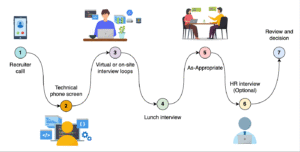
A coding interview is a technical assessment used by companies to evaluate a candidate’s ability to solve problems using code. During the interview, you are usually given a problem statement and asked to design and implement a solution. In most cases, the interviewer is less interested in whether you reach the final answer quickly and more interested in how you think through the problem.
Interviewers carefully observe how you analyze requirements, ask clarifying questions, and break down complex problems into manageable parts. They want to understand whether you can reason logically, recognize patterns, and apply appropriate data structures and algorithms. Communication is also critical. A candidate who explains their approach clearly often performs better than someone who writes code silently, even if both reach similar solutions.
Coding interviews are meant to simulate real engineering work. In real projects, engineers rarely face perfectly defined problems. Instead, they must interpret requirements, consider edge cases, and make trade-offs between performance, readability, and maintainability. Coding interviews reflect this reality.
Why data structures and algorithms are central to interviews
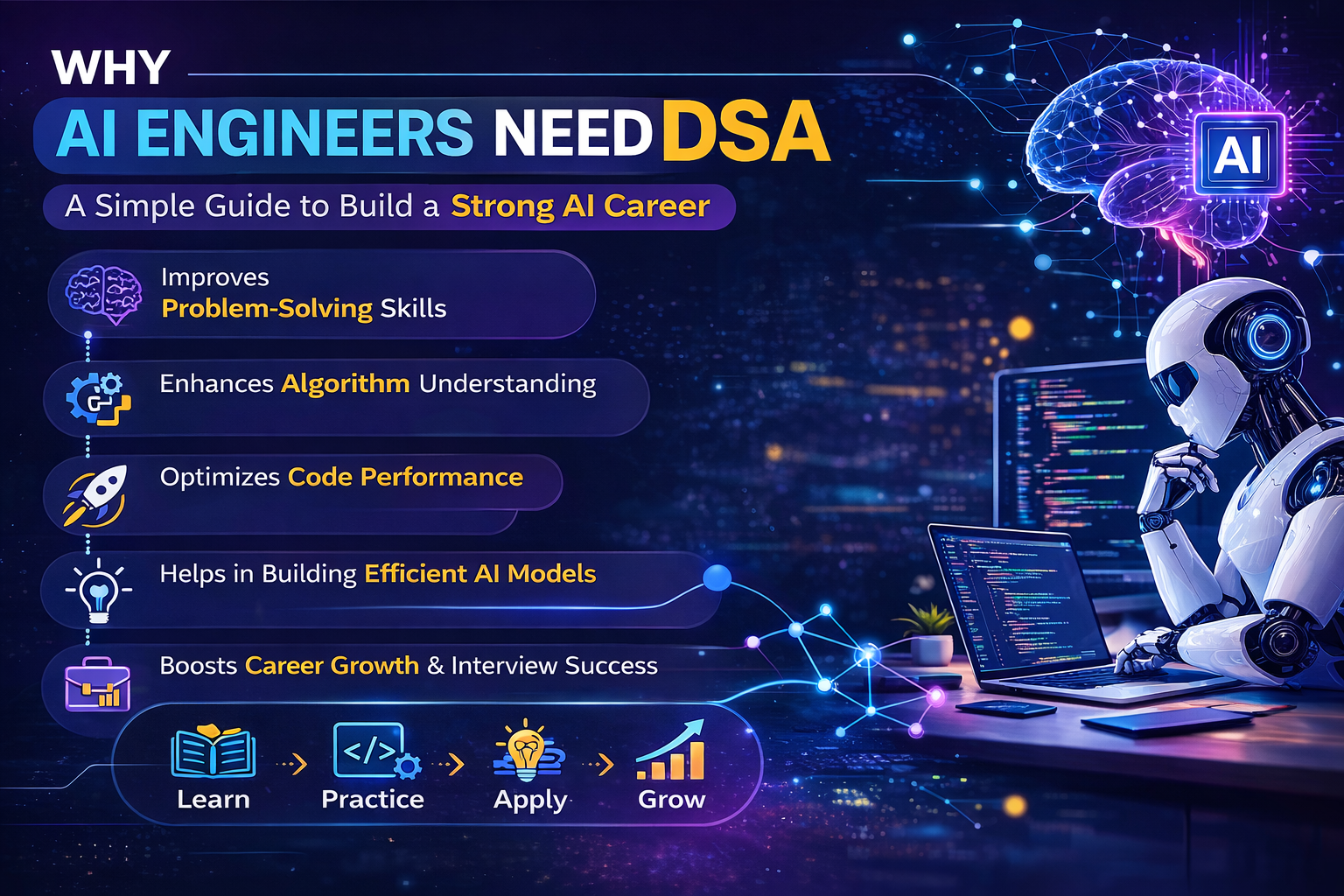
Data structures and algorithms form the backbone of most coding interview questions. Data structures define how data is organized and stored, while algorithms describe how that data is processed. Choosing the right data structure and algorithm often makes the difference between an efficient solution and one that fails due to performance issues.
Interviewers rely on data structures and algorithms because they reveal a candidate’s depth of understanding. Someone who truly understands these concepts can adapt their knowledge to new problems. Someone who memorizes solutions without understanding struggles when the problem changes slightly.
Another reason these topics are so important is scalability. Interview questions often involve large input sizes, and inefficient solutions may work for small inputs but fail for larger ones. Understanding time complexity and space complexity helps candidates design solutions that scale.
Building strong fundamentals before advanced topics
Before attempting complex problems, it is essential to build strong fundamentals. Many candidates rush into solving difficult problems without fully understanding basic concepts. This often leads to frustration and slow progress.
Fundamentals include understanding arrays, strings, linked lists, stacks, queues, and hash tables. These structures appear frequently in coding interviews because they are simple yet powerful. A deep understanding of these basics allows you to solve a wide range of problems with confidence.
Strong fundamentals also reduce cognitive load during interviews. When basic operations feel natural, you can focus on problem-solving rather than syntax or implementation details.
Arrays and Strings as the foundation of problem solving
Arrays and strings are among the most commonly tested topics in coding interviews. Although they appear simple, interviewers often design complex problems using these structures to test deeper problem-solving skills.
Array problems frequently involve iterating over elements, tracking indices, or modifying values in place. String problems often involve parsing characters, identifying patterns, or manipulating substrings. These problems may require techniques such as two pointers, sliding windows, or prefix sums.
Understanding how arrays are stored in memory and how indexing works is important for analyzing performance. Knowing which operations are constant time and which are linear helps you design efficient solutions. For strings, understanding immutability and character encoding can also be useful.
Arrays and strings are often used as building blocks for more advanced problems. For example, dynamic programming problems frequently use arrays to store intermediate results, and graph problems often use arrays or strings to represent nodes.
The importance of edge cases in interview problems
One of the most common reasons candidates fail coding interviews is ignoring edge cases. Even when the main logic of a solution is correct, missing edge cases can cause incorrect behavior.
Edge cases include situations such as empty input, single-element input, duplicate values, or extremely large input sizes. Interviewers often test these scenarios intentionally to see whether candidates think beyond the most obvious cases.
Discussing edge cases during an interview demonstrates attention to detail and experience. It shows that you are not only focused on solving the main problem but also on ensuring robustness and correctness.
Linked lists and pointer manipulation
Linked lists are frequently used in coding interviews to test a candidate’s understanding of pointers and memory references. Unlike arrays, linked lists do not allow direct indexing. Instead, you must traverse the list node by node.
Interviewers use linked list problems to evaluate whether candidates can manipulate pointers safely without losing access to nodes. Common tasks include reversing a linked list, detecting cycles, merging lists, or finding the middle node.
These problems require careful handling of references and null values. Mistakes in pointer manipulation often lead to runtime errors, which is why interviewers consider linked lists a good test of attention to detail.
Understanding linked lists also helps with other topics such as trees and graphs, which rely on similar traversal concepts.
Time complexity and space complexity explained clearly
Time complexity and space complexity are essential concepts in coding interviews. They describe how an algorithm’s performance changes as the input size grows.
Time complexity focuses on how long an algorithm takes to run, while space complexity focuses on how much additional memory it uses. Interviewers expect candidates to analyze both aspects of their solutions.
Understanding Big O notation allows you to compare different approaches objectively. For example, a solution with quadratic time complexity may be acceptable for small inputs but unacceptable for large ones. Interviewers often ask follow-up questions to see whether you can optimize your solution.
Discussing complexity also demonstrates that you think beyond correctness and consider real-world constraints.
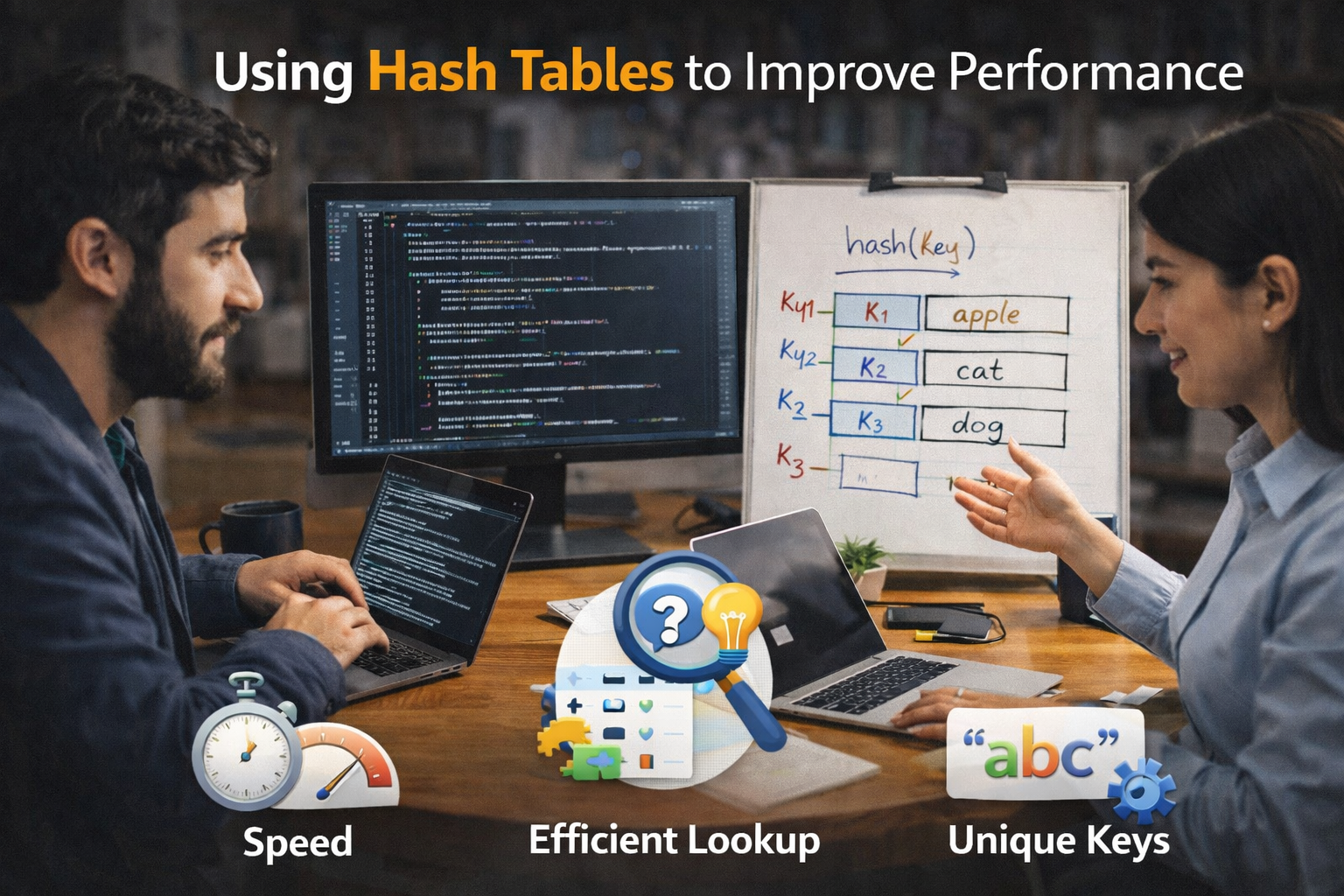
Using hash tables to improve performance
Hash tables are powerful tools for optimizing solutions. They allow fast lookups, insertions, and deletions, often in constant time. Many coding interview problems that appear difficult at first can be simplified using a hash table.
Common use cases include counting frequency, tracking visited elements, and checking for duplicates. Hash tables often help reduce time complexity from quadratic to linear.
However, hash tables use extra memory. Interviewers may ask whether the trade-off between time and space is acceptable. Being able to explain why you chose a hash table shows thoughtful decision-making.
Recursion as a problem-solving technique
Recursion is a technique where a function calls itself to solve smaller versions of a problem. It is commonly used in problems involving trees, graphs, and divide-and-conquer strategies.
Understanding recursion requires understanding base cases, recursive calls, and the call stack. Interviewers expect candidates to explain how recursion works and how it affects memory usage.
Although recursion can make code elegant and concise, it can also cause stack overflow if used incorrectly. Interviewers may ask about recursion depth and how to convert recursive solutions into iterative ones when necessary.
Backtracking and exploring solution spaces
Backtracking is a specialized form of recursion used to explore all possible solutions to a problem. It is commonly used in problems involving combinations, permutations, and constraints.
Backtracking works by making a choice, exploring its consequences, and then undoing the choice if it leads to an invalid solution. Interviewers focus on whether candidates can manage this process correctly and efficiently.
Understanding how to prune invalid paths early is crucial for optimizing backtracking solutions. Clear explanation of the decision-making process is often more important than writing the code quickly.
Trees and recursive thinking
Trees are a fundamental data structure in coding interviews. They represent hierarchical relationships and are often solved using recursion.
Interviewers expect candidates to understand tree traversal methods such as preorder, inorder, and postorder traversal. They also expect candidates to analyze tree height, depth, and balance.
Tree problems test both recursion and problem decomposition. A strong understanding of trees makes it easier to solve problems involving binary search trees, heaps, and graphs.
Graphs and real-world modeling
Graphs represent relationships between entities and are used to model real-world systems such as social networks, maps, and dependencies. Graph problems are common in advanced coding interviews.
Interviewers often test graph traversal techniques such as breadth-first search and depth-first search. They also evaluate whether candidates can track visited nodes and avoid infinite loops.
Explaining how a graph problem maps to a real-world scenario can make your solution easier to understand and demonstrate strong modeling skills.
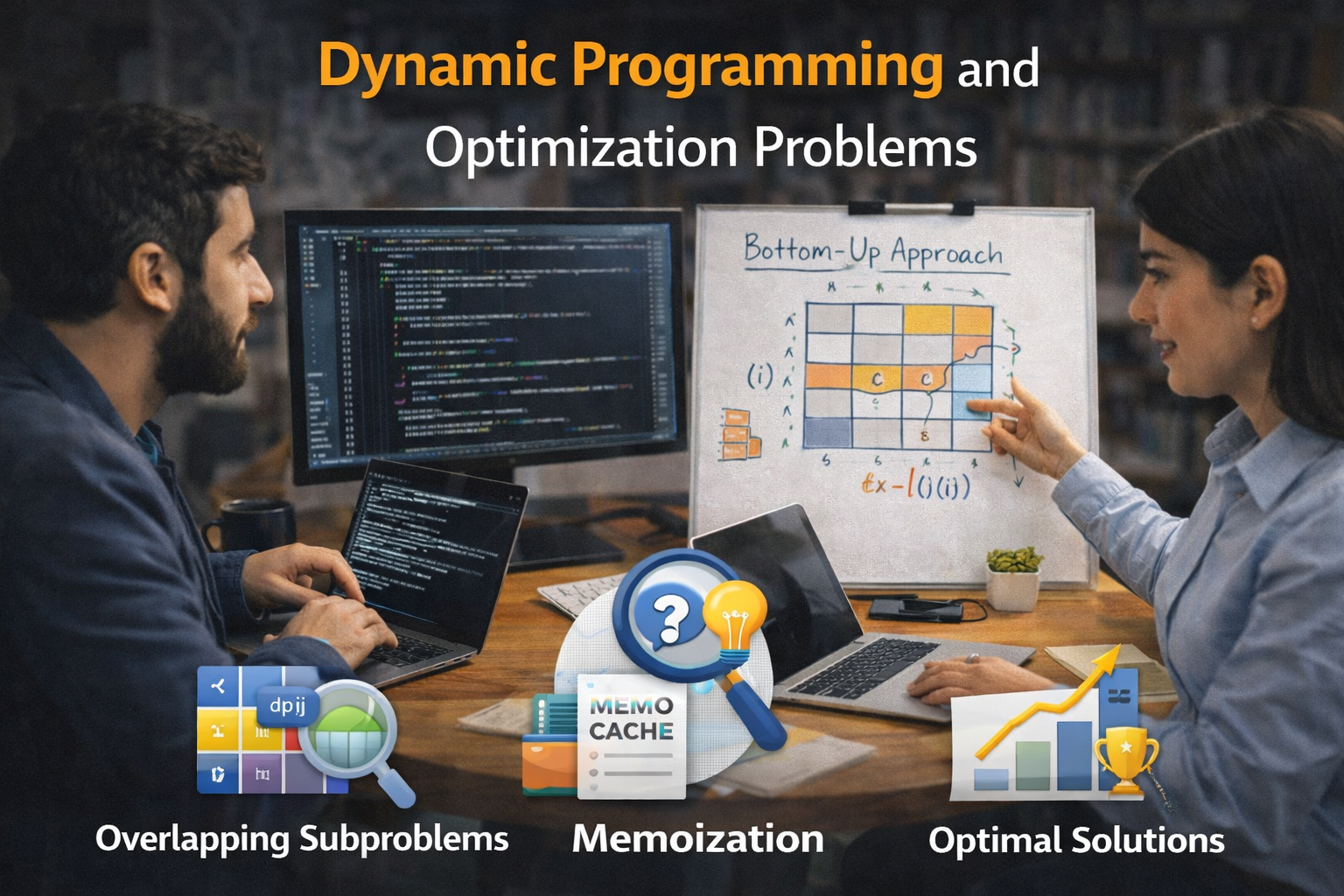
Dynamic programming and optimization problems
Dynamic programming is a technique used to solve problems with overlapping subproblems and optimal substructure. Although dynamic programming problems can seem intimidating, most follow a small set of patterns.
Interviewers expect candidates to identify these patterns, define subproblems clearly, and store intermediate results to avoid repeated work. Explaining the reasoning behind a dynamic programming solution is often more important than the final code.
Practicing effectively for coding interviews
Effective practice is not about solving as many problems as possible. It is about understanding patterns, learning from mistakes, and improving problem-solving skills.
High-quality practice involves reviewing solutions, analyzing alternative approaches, and understanding why certain techniques work. Consistency matters more than intensity. Practicing a little each day is often more effective than cramming.
This is exactly why most engineers don’t fail due to lack of effort, they fail due to lack of structure. If you want a personalized roadmap instead of guessing, our Career Mapping Program helps engineers identify gaps and prepare with clarity to land interviews and clear interviews to land job offers.
Link:
🔗 Career Guidance Program – Land Interviews – Resume review & job search tips – Everyone Who Codes
🔗 1:1 DSA/ System Design/ Behavioural Interview Mentorship to land job offers – 1 : 1 Tech Mentorship – Everyone Who Codes
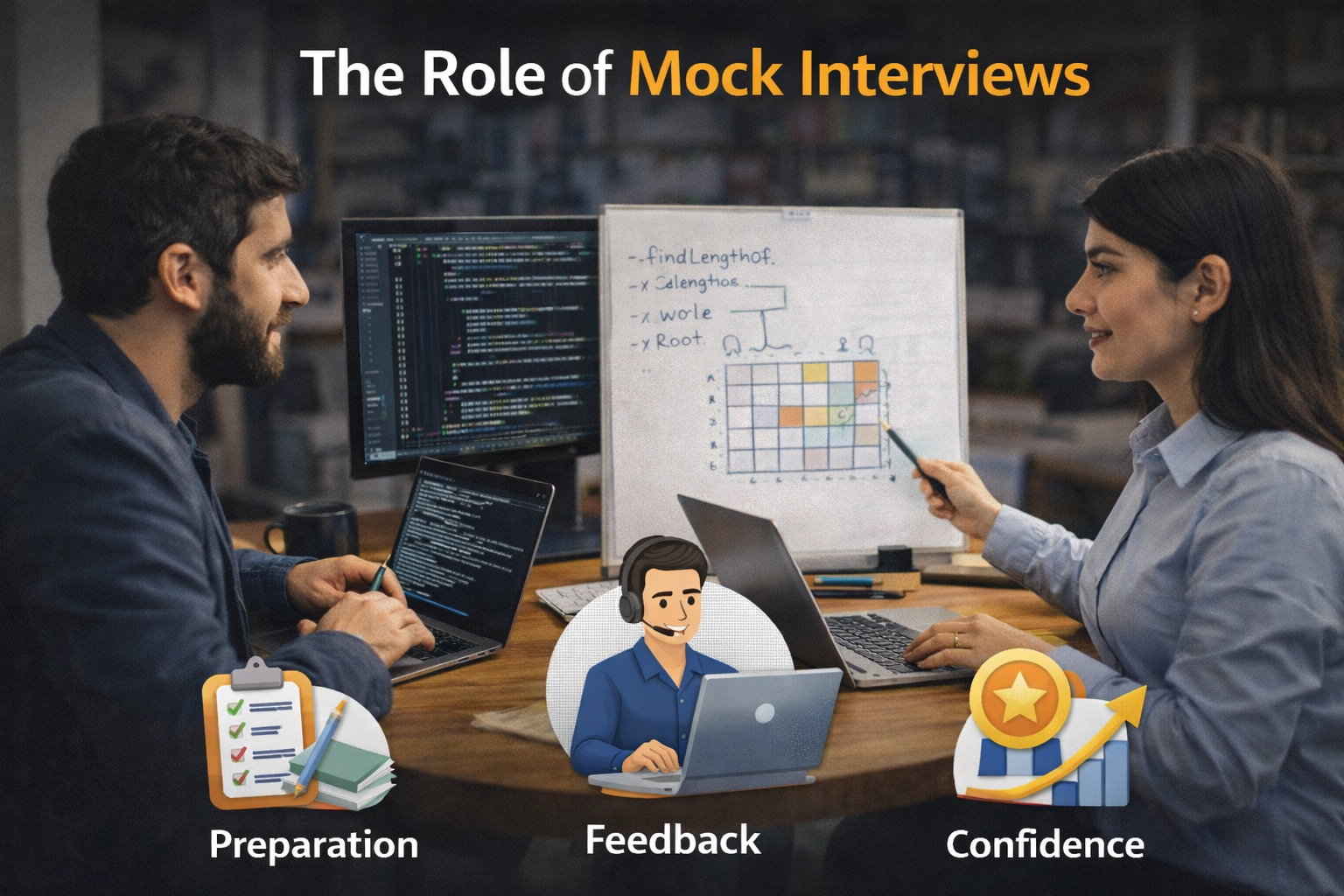
The role of mock interviews
Mock interviews simulate real interview conditions and help reduce anxiety. They allow you to practice explaining your thought process under pressure.
Mock interviews also reveal weaknesses that may not appear during solo practice. Improving communication and time management through mock interviews significantly increases interview performance.
Final thoughts on coding interview preparation
Coding interviews are challenging, but they are also predictable. Most interviews test a common set of data structures, algorithms, and problem-solving techniques. By building strong fundamentals, practicing consistently, and focusing on clear communication, you can greatly improve your chances of success.
Coding interviews are not about knowing everything. They are about thinking clearly, learning continuously, and demonstrating your ability to solve problems effectively. With the right preparation, coding interviews become an opportunity to showcase your skills rather than a source of stress.
This is why we run real FAANG-style mock interviews with senior engineers, not generic practice, but real pressure simulations with direct feedback.
Links:
🔗 1:1 Mock Interviews – DSA/ System Design / Behavioural Interview – Mock Interviews – Everyone Who Codes

Frequently Asked Questions (FAQ)
What are coding interviews, and what do they evaluate?
Coding interviews evaluate a candidate’s problem-solving ability, understanding of data structures and algorithms, coding skills, and communication. Interviewers focus on how you think, explain solutions, and handle edge cases, not just whether your code works.
How long does it take to prepare for coding interviews?
Preparation time depends on experience. Beginners typically need four to six months, intermediate developers need two to three months, and experienced engineers may need one to two months of focused practice. Consistency is more important than speed.
Which data structures should I prioritize for coding interviews?
You should prioritize arrays, strings, linked lists, stacks, queues, hash tables, trees, and graphs. These data structures form the foundation of most coding interview problems.
Why are time complexity and space complexity important?
Time and space complexity show how a solution scales with input size. Interviewers expect candidates to analyze performance using Big O notation and discuss trade-offs between efficiency and memory usage.
Is it acceptable to start with a brute-force solution?
Yes. Starting with a brute-force solution is often encouraged. Interviewers want to see your thought process and how you improve an initial solution into a more efficient one.
How important are edge cases in coding interviews?
Edge cases are very important. Ignoring cases like empty input, single-element input, or large data sets can cause an otherwise correct solution to fail.
When should I use recursion or backtracking?
Recursion and backtracking are useful for problems involving trees, graphs, combinations, and permutations. You should always explain base cases, recursion depth, and how constraints are handled.
Why are trees and graphs commonly asked in interviews?
Trees and graphs represent hierarchical and relational data. Interviewers use them to test recursive thinking, traversal techniques, and real-world modeling skills.
How should I practice coding interview problems effectively?
Effective practice focuses on recognizing patterns, reviewing mistakes, and understanding why solutions work. Solving fewer problems deeply is better than solving many problems superficially.
Do mock interviews really help?
Yes. Mock interviews simulate real interview conditions, improve communication and time management, and significantly reduce anxiety during actual coding interviews.
Want a Personalized Plan to land interviews and clear them to land job offers?
If you want a structured roadmap, real feedback, and mentorship from FAANG engineers, here is how we can help:
- Career Guidance Program (to get interview calls) – Resume review & job search tips – Everyone Who Codes
- 1:1 DSA / System Design / Interview Mentorship to clear interviews – 1 : 1 Tech Mentorship – Everyone Who Codes
- Real Mock Interviews with Expert FAANG Engineers – Mock Interviews – Everyone Who Codes