Artificial Intelligence is no longer a futuristic technology discussed only in research labs. In 2026, AI is powering search engines, recommendation systems, self-driving technology, healthcare diagnostics, and even software development tools. As a result, the demand for skilled AI engineers has skyrocketed across industries.
However, many beginners struggle because they start learning AI without a structured learning path. They jump from random tutorials to isolated projects and end up feeling overwhelmed.
That is exactly why an AI Engineer Roadmap is important. A clear roadmap shows what to learn, when to learn it, and how each skill connects to the bigger picture.
In this comprehensive guide, you will discover the AI Engineer Roadmap for 2026, including essential programming skills, machine learning foundations, deep learning expertise, and modern AI tools such as LLMs and AI agents. By the end of this article, you will understand exactly how to start your journey and build the skills companies expect from AI engineers today.
Why the AI Engineer Roadmap matters in 2026
The AI landscape has evolved dramatically in recent years. Earlier, knowing machine learning algorithms and Python libraries was enough to enter the field. Today, the role of an AI engineer is much broader.
Companies expect engineers who can build, deploy, scale, and monitor AI systems in production. Running experiments in a notebook is no longer sufficient. AI engineers now work with cloud infrastructure, large language models, data pipelines, and production APIs.
Because of this shift, following a structured AI Engineer Roadmap helps you avoid wasting time on unnecessary topics while focusing on skills that matter in the real industry.
A modern AI engineer typically works on tasks such as designing AI systems that solve business problems, adapting large language models, building intelligent applications, deploying models to cloud platforms, and ensuring the reliability and safety of AI systems. These responsibilities make the role both challenging and highly rewarding.
If you are serious about preparing DSA/ System design the right way, you should explore https://everyonewhocode.com/. https://everyonewhocode.com/services/mastering-data-structures-algorithms/
Mastering System Design for Interviews | EveryoneWhoCode
🔗 Career Guidance Program – Land Interviews – Resume review & job search tips – Everyone Who Codes
🔗 1:1 DSA/ System Design/ Behavioural Interview Mentorship – 1 : 1 Tech Mentorship – Everyone Who Codes
🔗 1:1 Mock Interviews – DSA/ System Design / Behavioral Interview – Mock Interviews – Everyone Who Codes
Understanding what an AI engineer actually does
Before diving into the AI Engineer Roadmap, it is important to understand what AI engineers actually do on a daily basis.
An AI engineer sits at the intersection of software engineering, machine learning, and data engineering. Their job is to transform intelligent models into real-world applications that people can use.
This means building machine learning pipelines, integrating models into applications, creating APIs for AI services, and ensuring that models remain accurate and efficient over time.
In modern AI teams, engineers also work with generative AI systems, multimodal models, and intelligent agents that automate complex workflows. The goal is not only to build accurate models but to create reliable AI products.
This understanding will help you follow the AI Engineer Roadmap with the right mindset.
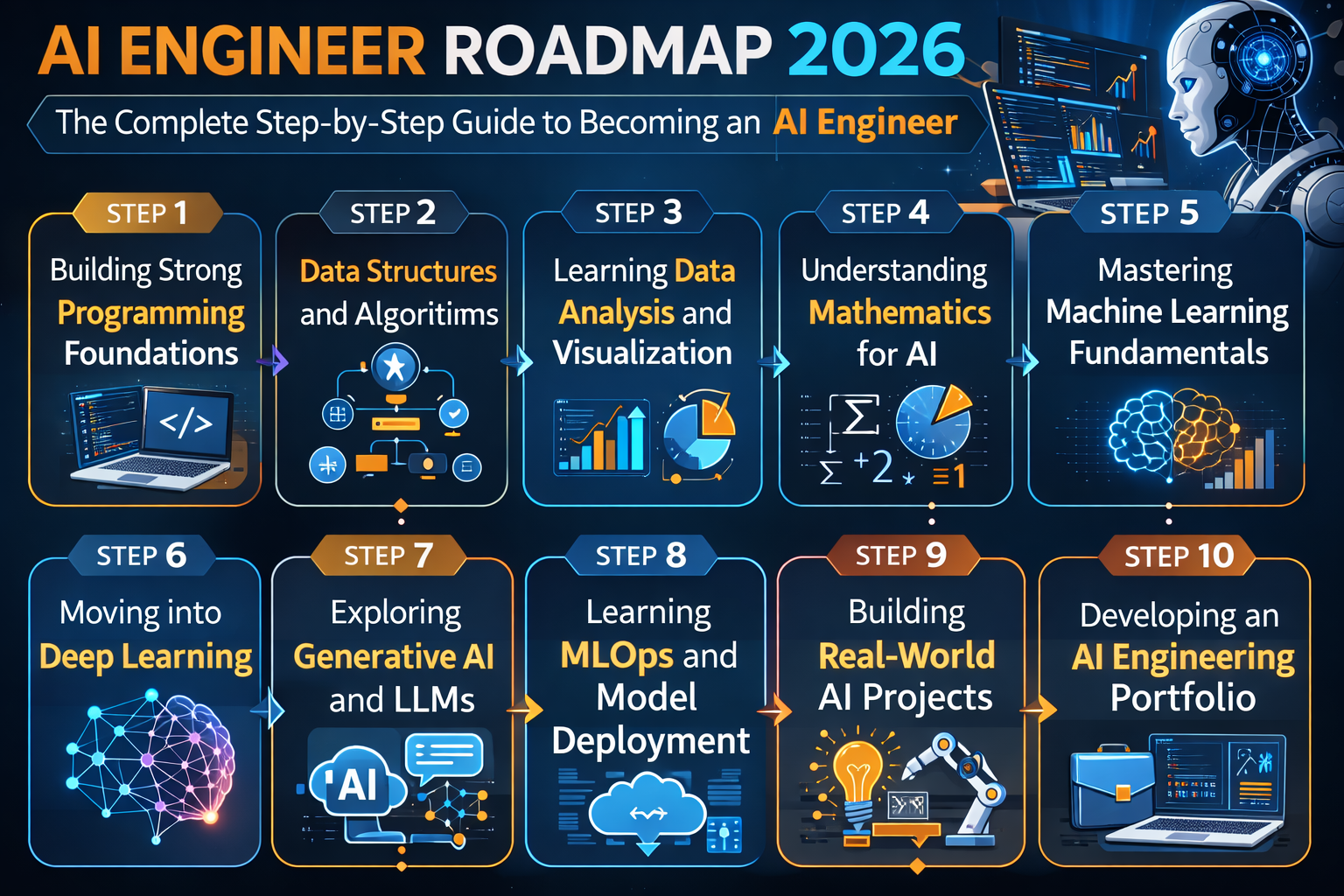
Step 1: Building strong programming foundations
The first stage of the AI Engineer Roadmap begins with programming. Python has become the dominant programming language in artificial intelligence because of its simplicity and extensive ecosystem.
As a beginner, you need to focus on core programming concepts such as variables, loops, functions, object-oriented programming, and error handling. These fundamentals are essential because every AI system eventually becomes a software system.
Beyond basic Python, it is also important to understand how to write clean and efficient code. AI engineers often process large datasets and complex models, so writing optimized code is critical.
In addition to Python, you should learn version control using Git and GitHub. Version control allows you to track changes, collaborate with teams, and showcase your projects to potential employers. According to community learning resources such as AI Engineer Roadmap version control is considered a fundamental skill in most engineering roadmaps.
Without solid programming skills, progressing through the rest of the AI Engineer Roadmap becomes extremely difficult.
Step 2: Data structures and algorithms
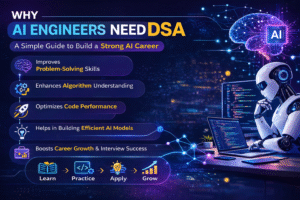
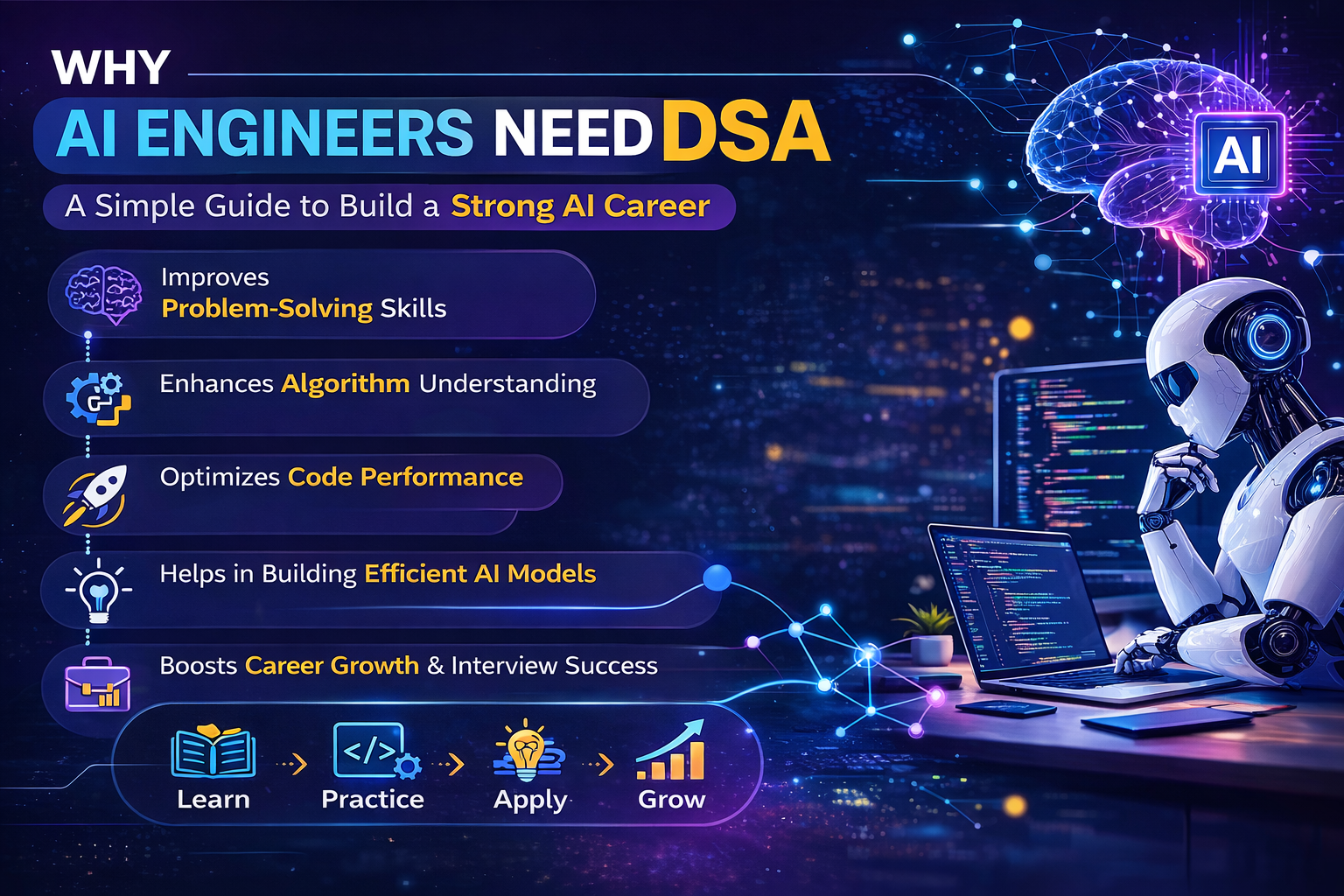
Many beginners overlook data structures and algorithms when learning AI, but they play a crucial role in building scalable systems.
AI engineers frequently handle large datasets, complex pipelines, and real-time applications. Understanding data structures such as arrays, linked lists, trees, and graphs helps you write efficient programs.
Algorithms also improve problem-solving skills. Concepts such as searching, sorting, recursion, and time complexity help engineers optimize performance when working with large machine learning models.
Although AI roles are not as algorithm-heavy as traditional software engineering roles, mastering these concepts makes you a stronger engineer overall.
In the AI Engineer Roadmap, this stage builds the foundation for writing scalable AI applications.
Step 3: Learning data analysis and visualization
Artificial intelligence is fundamentally driven by data. Before training models, AI engineers must analyze and understand the datasets they work with.
This is where tools like NumPy, Pandas, and data visualization libraries become essential.
NumPy helps with numerical computation and matrix operations. Pandas is widely used for data manipulation and cleaning. Visualization libraries such as Matplotlib and Seaborn allow engineers to explore patterns in data and communicate insights clearly.
SQL is another valuable skill in this stage of the AI Engineer Roadmap. Most organizations store their data in databases, so AI engineers often write queries to extract and transform datasets before training models.
By mastering data analysis, you gain the ability to prepare high-quality datasets, which directly impacts the performance of AI models.
Step 4: Understanding mathematics for AI
Mathematics is the backbone of artificial intelligence. However, you do not need to become a mathematician to become an AI engineer.
Instead, focus on key mathematical concepts that support machine learning and deep learning.
Linear algebra helps you understand vectors, matrices, and transformations used in neural networks. Probability and statistics explain how models make predictions and evaluate uncertainty. Concepts such as mean, variance, and probability distributions are used extensively in machine learning.
Learning these concepts improves your intuition about how AI models work. Instead of blindly applying algorithms, you will understand why certain methods perform better than others.
This stage of the AI Engineer Roadmap strengthens your theoretical understanding and prepares you for advanced AI concepts.
Step 5: Mastering machine learning fundamentals
Machine learning is the core of the AI Engineer Roadmap. At this stage, you start building models that can learn patterns from data.
Machine learning includes supervised learning techniques such as regression and classification, as well as unsupervised learning methods like clustering.
You will also learn about feature engineering, which involves selecting and transforming input variables to improve model performance. Evaluation metrics such as accuracy, precision, recall, and F1 score are used to measure how well a model performs.
Frameworks like Scikit-learn make it easier to implement machine learning algorithms and experiment with datasets.
Working on practical projects is extremely important in this stage of the AI Engineer Roadmap. Projects such as predicting house prices, detecting spam emails, or building recommendation systems help you gain hands-on experience.
Real projects demonstrate your ability to apply theoretical knowledge to real problems.
Step 6: Moving into deep learning
Deep learning represents the next level in the AI Engineer Roadmap. While traditional machine learning relies on structured features, deep learning allows models to automatically learn complex patterns.
Deep learning is based on neural networks, which mimic the structure of the human brain. These networks are capable of solving tasks such as image recognition, speech processing, and language understanding.
Popular frameworks for deep learning include TensorFlow and PyTorch. These tools allow engineers to design neural networks, train models on large datasets, and deploy them in production environments.
Important architectures in deep learning include convolutional neural networks for computer vision and recurrent neural networks for sequential data. More recently, transformer architectures have revolutionized natural language processing.
Understanding these models prepares you for modern AI systems that power applications like chatbots and generative AI platforms.
Step 7: Exploring generative AI and large language models
Generative AI has become one of the most exciting areas in the AI Engineer Roadmap. Technologies such as large language models have transformed how software interacts with users.
Instead of writing rigid programs, developers can now build intelligent systems capable of generating text, answering questions, summarizing documents, and even writing code.
Modern AI engineers work with technologies such as embeddings, vector databases, and retrieval-augmented generation systems. These techniques allow applications to combine large language models with external knowledge sources.
Frameworks such as LangChain and other orchestration tools help developers build AI agents capable of performing multi-step reasoning tasks.
Learning generative AI is an essential part of the modern AI Engineer Roadmap because many companies are integrating AI assistants and intelligent automation into their products.
Step 8: Learning MLOps and model deployment
Building a model is only part of the job. Real AI engineers must deploy models into production systems.
This is where MLOps, or Machine Learning Operations, becomes important.
MLOps focuses on managing the lifecycle of machine learning models. It includes versioning models, automating training pipelines, monitoring model performance, and updating models when data changes.
Tools like Docker help package applications for deployment, while frameworks such as FastAPI allow engineers to expose machine learning models as APIs.
Cloud platforms such as AWS, Azure, and Google Cloud are also widely used for deploying AI systems.
This stage ensures that the AI Engineer Roadmap transitions from experimentation to real-world impact.
Step 9: Building real-world AI projects
Projects are the most important part of the AI Engineer Roadmap. Employers rarely hire candidates based only on theoretical knowledge.
Instead, they look for engineers who have built real applications.
Examples of strong AI projects include intelligent chatbots, recommendation engines, AI document analyzers, image recognition systems, and AI-powered search tools.
Projects demonstrate your ability to design, implement, and deploy AI systems. They also serve as portfolio pieces that you can showcase on GitHub or professional profiles.
Consistently building projects accelerates learning and increases your chances of landing an AI engineering role.
Step 10: Developing an AI engineering portfolio
The final stage of the AI Engineer Roadmap focuses on personal branding and professional visibility.
In today’s tech industry, your online presence acts as your resume. Engineers who share their work publicly often receive more opportunities.
Maintaining a GitHub portfolio with well-documented AI projects helps recruiters evaluate your skills. Writing blog posts about AI concepts also strengthens your understanding and demonstrates communication skills.
Participating in open-source projects and data science competitions can further enhance your credibility as an AI engineer.
These activities help transform your learning journey into a professional career.
If you are serious about preparing DSA/ System design the right way, you should explore https://everyonewhocode.com/. https://everyonewhocode.com/services/mastering-data-structures-algorithms/
Mastering System Design for Interviews | EveryoneWhoCode
🔗 Career Guidance Program – Land Interviews – Resume review & job search tips – Everyone Who Codes
🔗 1:1 DSA/ System Design/ Behavioural Interview Mentorship to land job offers – 1 : 1 Tech Mentorship – Everyone Who Codes
The future of AI engineering
Artificial intelligence continues to evolve rapidly. New research breakthroughs, improved computing power, and growing industry adoption are expanding the possibilities of AI systems.
In the coming years, AI engineers will likely work more with autonomous AI agents, multimodal models that combine text, image, and audio understanding, and scalable AI infrastructure.
Despite these changes, the fundamentals of the AI Engineer Roadmap will remain relevant. Strong programming skills, mathematical understanding, machine learning knowledge, and system design expertise will always form the core of AI engineering.
By following a structured roadmap and consistently building projects, anyone with dedication and curiosity can enter this field.
Final thoughts on the AI Engineer Roadmap
The journey to becoming an AI engineer may seem overwhelming at first, but breaking it down into clear stages makes the process manageable.
Start by mastering programming and problem solving. Build a strong understanding of data and mathematics. Progress into machine learning and deep learning. Explore modern technologies such as generative AI and AI agents. Finally, focus on deploying models and building real applications.
Following this AI Engineer Roadmap step by step will help you develop the skills needed to succeed in one of the most exciting careers of the modern technology era.
Artificial intelligence is shaping the future of nearly every industry. By starting your journey today and staying consistent with the AI Engineer Roadmap, you position yourself at the forefront of one of the most transformative technological revolutions in history.
Frequently Asked Questions (FAQ)
What skills are required to become an AI engineer in 2026?
To become an AI engineer in 2026, you need a combination of programming, mathematics, machine learning, and software engineering skills. Core skills include Python programming, data structures and algorithms, statistics, linear algebra, machine learning, deep learning frameworks like TensorFlow or PyTorch, and experience with deploying models using cloud platforms and MLOps tools.
How long does it take to become an AI engineer?
The time required depends on your background. Someone with programming experience may take 6–12 months to learn AI fundamentals and build projects. Beginners starting from scratch may need 12–24 months to develop strong skills in programming, machine learning, and AI system development.
Is Python necessary for becoming an AI engineer?
Yes, Python is considered the most important programming language in AI. Most machine learning libraries such as NumPy, Pandas, Scikit-learn, TensorFlow, and PyTorch are built around Python. Its simplicity and large ecosystem make it the preferred language for AI engineers.
Do AI engineers need to know mathematics?
Yes, mathematics is an important foundation for AI. Key areas include linear algebra, probability, statistics, and calculus. These concepts help you understand how machine learning algorithms and neural networks work and improve your ability to build and optimize models.
What is the difference between an AI engineer and a data scientist?
A data scientist primarily focuses on analyzing data and building predictive models. An AI engineer focuses on building, deploying, and scaling AI systems in real applications. AI engineers often work with APIs, cloud infrastructure, and production systems to deliver AI-powered products.
What projects should beginners build to become AI engineers?
Good beginner AI projects include:
- Spam email classifier
- House price prediction model
- Recommendation system
- Chatbot using large language models
- Image classification system
Projects demonstrate practical skills and help build a strong portfolio.
What are the best tools and frameworks AI engineers should learn?
Popular AI tools and frameworks include:
- NumPy and Pandas for data processing
- Scikit-learn for machine learning
- TensorFlow or PyTorch for deep learning
- LangChain and vector databases for LLM applications
- Docker and FastAPI for deployment
- Cloud platforms like AWS, Azure, and Google Cloud
These tools help engineers build production-ready AI systems.
What is MLOps and why is it important for AI engineers?
MLOps (Machine Learning Operations) is the practice of deploying, managing, and monitoring machine learning models in production environments. It ensures models remain reliable, scalable, and updated when data changes. MLOps tools help automate training pipelines, version models, and track performance.
Is generative AI important for AI engineers today?
Yes, generative AI has become a major part of modern AI development. Technologies like large language models (LLMs), embeddings, vector databases, and AI agents allow engineers to build intelligent applications such as chatbots, document analyzers, and AI assistants.
How can I build a strong AI engineer portfolio?
A strong AI portfolio should include:
- Multiple real-world AI projects
- Well-documented GitHub repositories
- Deployed AI applications or APIs
- Blog posts explaining your projects
- Participation in open-source or AI competitions
A well-structured portfolio helps recruiters evaluate your practical AI engineering skills.
Want a Personalized Plan to land interviews and clear them to land job offers?
If you want a structured roadmap, real feedback, and mentorship from FAANG engineers, here is how we can help:
- Career Guidance Program (to get interview calls) – Resume review & job search tips – Everyone Who Codes
• 1:1 DSA / System Design / Interview Mentorship to clear interviews – 1 : 1 Tech Mentorship – Everyone Who Codes - Real Mock Interviews with Expert FAANG Engineers – Mock Interviews – Everyone Who Codes
If you are serious about preparing DSA/ System design the right way, you should explore https://everyonewhocode.com/. https://everyonewhocode.com/services/mastering-data-structures-algorithms/